 My Jimdo Geocities Lifeboat
===========================
How the Soviet Union Turned a Plague into Propaganda
The fight against locust swarms allowed the Soviet Union to consolidate power over neighboring regions.
https://daily.jstor.org/how-the-soviet-union-turned-a-plague-into-propaganda/
============================
We seem to be stuck in a nigh-unbreakable cycle of negotiation, ceasefire, fighting, and escalation. This is a feedback loop entirely of our own creation. Thankfully, that also means we can break this deadly cycle. However, the two most obvious means of doing so—ramping up the combat or winding it down via diplomacy—both have serious problems that make them either highly risky or downright bad for American interests.
====================
======================================
Video link
https://youtu.be/SxoSk5BkugQ
Filename
Pipe and Drum Music Tralee Park 13 June 2026
=========================
When Jesus asks, "Which is easier, to say, 'your sins are forgiven,' or to say, 'rise and walk?'" he reveals the greatest healing is the one we cannot see: a forgiven soul restored for eternity. Christ desires to heal us completely, offering both mercy for our sins and the strength to walk in the newness of life.
Lord Jesus, heal what is broken within us.
-------------------------------
Prayer
Lord God,
whose days are without end
and whose mercies beyond counting,
keep us mindful
that life is short and the hour of death unknown.
Let your Spirit guide our days on earth
in the ways of holiness and justice,
that we may serve you
in union with the whole Church,
sure in faith, strong in hope, perfect in love.
And when our earthly journey is ended,
lead us rejoicing into your kingdom,
where you live for ever and ever. Amen.
Prayer for going on holiday
Heavenly Father,
please bless our holiday time.
Help our family to have patience and understanding.
Guide us to be mindful of this gift of time together.
Help us to make compromises when necessary and
handle any chaos that comes our way with Your love and grace.
Open our eyes to truly see the beauty of the memories we are creating.
Through Christ our Lord. Amen.
=========================================
NOTE FROM FR. JIM Lenihan ........
I once read about a distinguished man who visited a spiritual master, seeking
enlightenment. As he spoke proudly about his achievements, the master quietly
poured tea into a cup. Even after it was full, he kept pouring until it overflowed.
The visitor protested, “Stop! The cup is full.” The master replied, “Like this cup,
you are overflowing with your own opinions and achievements. How can I teach you
anything unless you first empty your cup?” The story leaves us with three
questions: How full is my own cup? How full of myself am I? Is there room
for God in my heart? Henri Nouwen once told fellow priests,
“If you’ve come
here today expecting nothing to happen to you, I promise you, you won’t go away
disappointed—because nothing will happen to you.” When we come to Holy Mass, do
we expect God to speak to us and change us, or do we simply come out of habit?
Let us come like a hungry child, aware of our need and trusting in God’s generosity.
May we come to the Eucharist with open hearts, allowing the Lord to fill us with
the grace only He can give.
=======================
Thought for the Week: Be gentle and humble in heart.
To the gentle and humble Jesus promises peace of soul. It is because we
know so little about being gentle with one another that we have so much
trouble in our homes and in the world. We want to dominate others. It is
because we know so little about humility that we have so little peace within
ourselves and with others. Humble people disarm others and bring out the
best in them.
----------------
Thought
First impressions can be misleading. It is easy to form quick judgments about others based on a brief encounter without knowing anything about their circumstances or struggles, and only later do we discover that what we assumed was in fact the sign of a hidden challenge they are experiencing.
Jesus teaches, “Stop judging, that you may not be judged.” Only God sees the heart clearly.
Lord, help us to refrain from rash judgment and to offer others the same mercy we so often need too.
==================
Love is not found primarily in the grand, heroic sacrifices that life occasionally asks of us, but in everyday patience—in carrying the weight of the ordinary. This patience, this daily love, urges us to grow in virtue, sanctifies us, and helps us not to lose hope or the meaning of our existence, which can sometimes seem so small.
================================
The Shrine of Our Lady of Champion, the only Church-approved Marian apparition in the United States, has created an opportunity for America’s Catholics to see the faces of the holy women and men who have been a light in America’s darkest hours.
Here are four of America’s holiest women and men all U.S. Catholics should know about:
=========================================
Here are 10 fascinating facts about St. Aloysius Gonzaga– a holy, young, 16th-century saint:
1) He was born into nobility.
Aloysius was born in 1568 to a wealthy Italian family with strong social standing. His life could have been one of privilege and power, but he wanted something greater than worldly success.
-----------------------------------------------------
There were a great many more Founding Fathers, however, even if their names are not so familiar as the above. Several of those lesser-known men who played key roles in the creation of the United States of America were Catholics. Chief among them were three members of the Carroll family of Maryland: Charles Carroll, the only Catholic signer of the Declaration of Independence; his cousin Daniel Carroll; and Daniel Carroll’s brother John Carroll, who became America’s first Catholic bishop.
Charles Carroll of Carrollton (1737-1832) was the most illustrious and best-known of the Carrolls.
https://catholiceducation.org/en/culture/catholic-founding-fathers-the-carroll-family.html
========================
https://charlescarrollhouse.org/the-carrolls/personal-biography-2
=================================
https://www.redemptoristslimerick.ie/live-webcam/
==================
Cholesterol, Statins, and Alzheimer's: What The Science Actually Says
https://youtu.be/c_mjXtASEZ0?si=dc-l1G-HzWaAq-r2
=====================================
==================================
Video link
https://youtu.be/Hw1WGepFRVg
Filename
Hay Bale June2026.mp4
=====================
https://www.govserv.org/IE/Limerick/2129783530655406/The-People%27s-Museum-of-Limerick
==========================
==================================
Podcast #1,122: The Retirement Trap — Should You Really Stop Working at 65?
============================
https://www.redemptoristslimerick.ie/live-webcam/
===============================
On Thursday I’ll be participating in an event at AEI — How Will the US Unleash Commercial Nuclear Power? — for which you can register to attend in person or online. As preparation for the event, over the next few days I’ll be publishing a three-part series on U.S. nuclear power. Today, I take a look at the construction costs of nuclear power and why the U.S. has seen those costs increase while several other countries have not. On Thursday, when I publish the final installment I’ll share an XLS file with all data, sources, and links from the series.
https://rogerpielkejr.substack.com/p/can-america-build-nuclear-again-part
=============================
This July 4, let's realign with the nation we were founded to be
======================
This is not the first time Messi publicly displayed his Catholic faith on the world stage. Messi often makes the Sign of the Cross and praises God for his accomplishments.
Just last week, Messi celebrated with the Sign of the Cross after his hat trick against Algeria.
===============
==================================
February 27, 2021
Knockanure Moyvane Listowel County Kerry
by Eileen McElligott
Maurice O’Connell was born at Glin Road, Moyvane in May 1936. His parents, Thomas and Mary (nee McMahon) O’Connell were both Principal Teachers in the local National School. Maurice must have been a very welcome addition to their family of six daughters! Another son, Thomas, followed later but died in infancy, and another daughter, Anna.
Pictured above are the current members of the
EMI (European Monetary Institute) Council.
Maurice O’Connell is in the back row, third from the left.
Following in the footsteps of his father and uncles, Maurice commenced his secondary education in St. Michael’s College, Listowel of which his grandfather, also Maurice O’Connell, was a co-founder and a brilliant Classics master for fifty years.
After a remarkable Intermediate Certificate in which he got first place in Ireland in Greek, he studied in St. Brendan’s Seminary, Killarney where he was also an outstanding student having got an illustrious result in his Leaving Certificate at sixteen years of age. He then went to Maynooth Ecclesiastical College and after three years he commenced a teaching career in Dublin, completed his M.A. in classics and subsequently taught in the International College in St. Gallen before returning to Dublin to embark on a Civil Service career. He was appointed Administrative Officer in the Department of Finance, and later Second Secretary in the same Department before his appointment as Governor of the Central Bank in 1994.
Married to Dubliner Marjorie Treacy, they have four adult children. Their sons Thomas and Martin, like five of Maurice’s nephews, chose the medical profession, while his two daughters Catherine and Marjorie is working on a Master’s degree.
Though he has traveled widely in Europe and beyond in the course of his career and has conferred with Princes and Prime Ministers, his family, his staff and the people of Moyvane – and his Glin Road neighbours in particular – come first.
Asked in a recent newspaper interview where his favourite place was, he simply replied “Kerry!”. Go mba fada buan é.
https://northkerry.wordpress.com/2021/02/27/knockanure-moyvane-listowel-county-kerry/
===============================
THE WALLS OF LIMERICK
DEPARTMENT OF HISTORY UNIVERSITY OF LIMERICK
https://youtu.be/AU5LDiI26VQ?si=oJerX4c0Xs4-IA4_
===================
China's Energy Breakthrough Just Replaced Oil — The US Has No Answer
https://youtu.be/Dp8fz0E2Q2Q?si=H6-2pE0JLMRmRIBZ
===================
Tesla's Giant Solar Factory Is Real & The Scale Is Hard to Believe
https://youtu.be/uSgpvk11bIk?si=3N2oEKw5hJS7JDCd
====================
Old Pictures Knockanure
https://youtu.be/2kMK5gv8ejY?si=3WVLZU0faik9kghy
=======================
Baptisms West Cork
https://docs.google.com/spreadsheets/d/1ZlOKW3lYj9K8zdG12cC-X8h4JYEOgkrNHKG_TbIgJB0/edit?gid=0#gid=0
=============
West Cork Baptisms
==================
WAR: 14 Powerful Images of the Mass in the Midst of War
"Almighty God, we commend to your gracious care and keeping all the men and women of our armed forces at home and abroad."
Prayer for Those Who Gave Their Lives in Service
O God, welcome into Your peace
those who gave their lives in service to others.
Grant them eternal rest,
comfort those who mourn,
and make us grateful stewards
of the freedom they defended.
Through Christ our Lord.
Amen.
==================
May 26, 2026
Divine Mystery: As immense as the universe and intimate as one’s breath
Recently, I went to liturgy at an abbey. It was a wondrous structure where, upon entering the body of the church, your eyes immediately lifted to the heavens. The priest was dwarfed by the upward movement of the architecture. I breathed deeply, caught in memories of being in the medieval cathedrals of Europe; amazing structures representing the work of human hands over generations, decades, even centuries, creating a psalm to glorify a God far above the earth, residing in another place named heaven, often pictured as sitting on a throne. Creating such a distance between God and us was intimidating, keeping one in one’s place, just like the societal structures of those centuries.
That day, however, was different. I continued to gaze upwards beyond the ceiling and imagined being on a trajectory into space beyond the boundaries of our planet. Having just seen the movie "Project: Hail Mary," it wasn’t too difficult to envision the galaxies, planets and millions of stars that enfold us. I always feel such awe and a sense of presence when I am under the night sky, especially away from all the ambient light of the city.
==============================
Tipperary
https://tipperarystudies.ie/?s=williams
Tipperary’s Olympians – Paddy Anglim, Amsterdam 1928
9th August 2016 Features, News
To celebrate the Rio Olympics were are putting the spotlight on Olympians with Tipperary connections that have represented Ireland on the world’s most famous and prestigious sporting stage. These articles were written by sports historian Michael O’Dwyer, and appeared originally during 2011/12 in the Tipperary Star.
https://tipperarystudies.ie/tipperarys-olympians-paddy-anglim-amsterdam-1928/
--------------------------
Tipperary’s Studies vast and ever growing collection on the county’s history and heritage includes books, journals, local newspapers, maps, images including photos and postcards, archives and ephemera. There is a large focus on making much of the unique Tipperary material available in digital format. As items are digitised they will be made available online. To that end you are encouraged to keep visiting here to see what is new.
https://www.tippstudiesdigital.ie/
========================
In June 2021 Tipperary Studies department of Tipperary County Council Library Service acquired 399 glass plate negatives. The images were taken during the latter half of the 1930s, which is apparent from some posters identified in several of the pictures. The photographer is unknown, as is the location where s/he originated from.
The collection is a wonderful visual representation of social and economic life
https://tipperarystudies.ie/images/munster-glass-plates-collection-c-1930s/
----------------------
https://tipperarystudies.ie/wp-content/uploads/2023/02/team-pic-Grenville-school-scaled.jpg
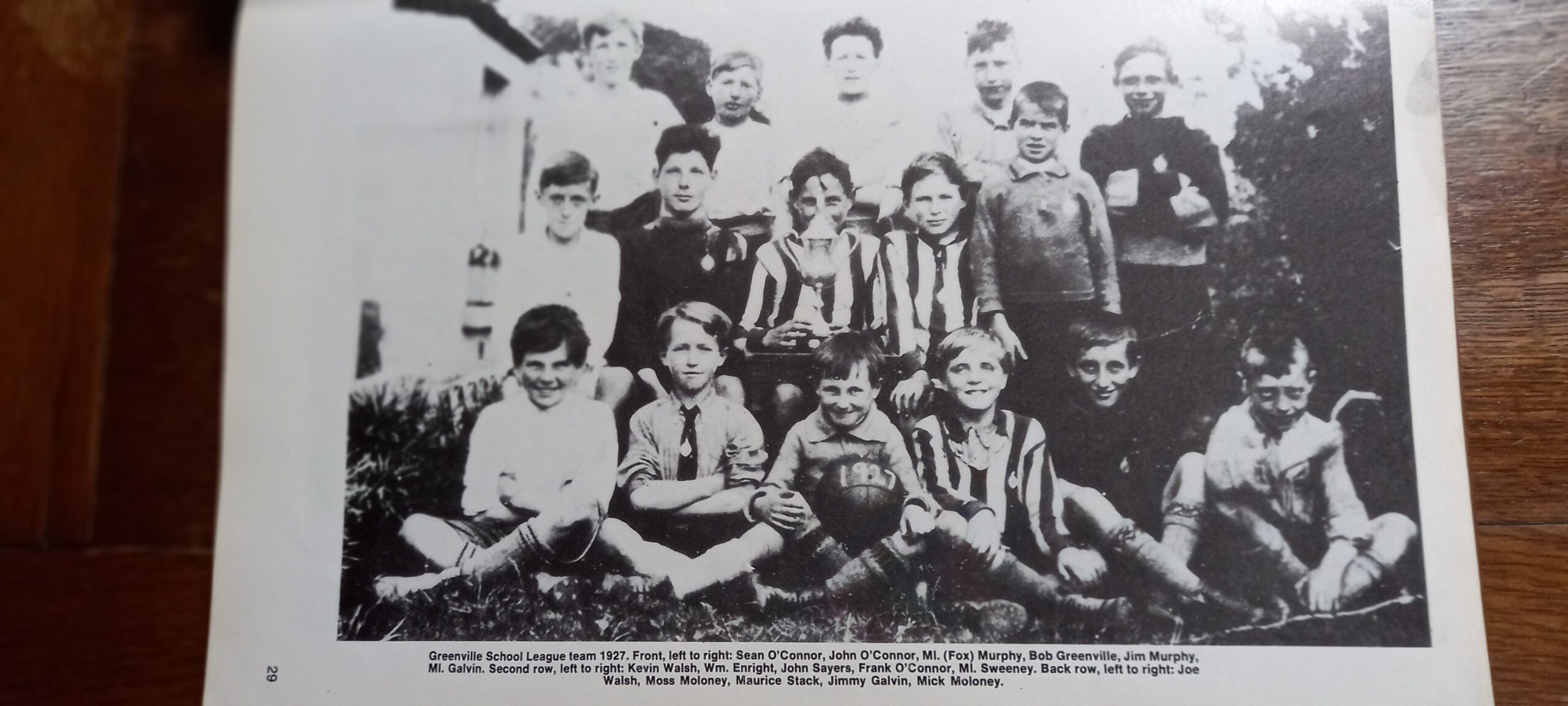
Listowel pictures
https://www.tippstudiesdigital.ie/search?query=listowel&submit_search=Search
------------------------------
Williams
https://www.tippstudiesdigital.ie/search?query=williams&submit_search=Search
----------------------------
Ballybunion; https://www.tippstudiesdigital.ie/search?query=ballybunion&submit_search=Search
---------------------
=========================
POPE
By Agnes Aineah
Algiers, 16 April, 2026 / 9:58 am (ACI Africa).
The Mediterranean Sea and the Saharan Desert risk becoming graveyards, Pope Leo XIX has warned, condemning the exploitation in the sea and desert where many Africans die while attempting to cross over to Europe.
In his April 13 meeting with the Authorities, Civil Society and The Diplomatic Corps at the “Djamaa el Djazair” Conference Center in Algeria, Pope Leo said that the Mediterranean and Sahara can be turned into “places of life, encounter and wonder.”
Noting that the sea and the desert have been “places of mutual enrichment among peoples and cultures for millennia”, the Holy Father said, “Woe to us if we turn them into graveyards where hope also dies!”
===============================
CHANGES: Life changes when you have children, and while parenting is undoubtedly the most rewarding role any of us will undertake, it can involve sacrifice.
This could mean giving up lie-ins and late nights for a few years, making do with less money, and turning down invitations because you don’t have a babysitter.
But it can also improve your life. Irish actor Colin Farrell told broadcaster Brendan O’Connor that his son, James, who has a rare condition, called Angelman syndrome, was the reason he quit alcohol.
When Farrell was in rehab doing the 12 step AA programme for alcoholism in 2005, it was the thought of his son James, born in 2003, that gave him the determination to keep going and kick the addiction.
https://www.irishexaminer.com/lifestyle/parenting/arid-41826374.html?utm_source=firefox-newtab-en-gb
==========================
Thought.
NOTE FROM FR. JIM Lenihan ......
Recently I read a line which read….We desire to draw near to God sometimes, but
Jesus desires to draw near to us all the time. That truth is very much revealed in
today’s Gospel—the Road to Emmaus. The two disciples on the road represent you
and me. Even though these two disciples saw firsthand Jesus preforming
incredible miracles like raising Lazarus from the dead, giving sight to the blind,
feeding the thousands. Yet still when things go wrong we tend to jump the faith
ship very easily. Even though at times we’re totally convinced that there’s nothing
impossible to God after seeing great miracles in our lives but when things don’t go
our way our faith can falter. We easily walk away from “Jerusalem,” which
symbolises walking away from ‘God’s Ways’. It can happen through-distraction,
discouragement, doubt, deception, and division. I often call these the five D’s of
the devil, which can so often place us on the wrong road that leads us away from
God. That is the bad news. The good news is that we have a God who loves us and
constantly searches for us. In today’s Gospel, even though the two disciples are
walking in the wrong direction, we see Jesus with great love and patience walking
that road with them. Even when we do not recognise Him, He is always with us.
Even when we are on the wrong path, He never gives up on us.
In today’s Gospel, Jesus does two things. First, He opens the Scriptures—the
Word of God—helping them understand that this was always God’s plan. Second,
He reveals Himself in the breaking of the bread, the Eucharist. Through prayer,
the study of God’s Word, and participation in the Mass and Eucharistic adoration,
our eyes can be opened. We can be transformed from being downcast and
discouraged to returning to God’s city with joy, zeal, and renewed faith.
Next month 14 young children from our parish will receive their First Holy
Communion, we pray that these young people and indeed their families will find the
‘Road to Jerusalem’ or in other words to a ‘Heavenly life’ by coming to love the
Eucharist, coming to love the Mass—the two tables: the table of the Word and
the table of the Eucharist. May Jesus always walk with us all, guiding us on the
right road that leads to an abundant life here on earth and in heaven
==============================
======================================
In Los Angeles, scientists are delighted to decode one of the richest fossil records on Earth
The challenge for La Brea, says Lindsey, is that it’s “a spectacle, and it’s also in the middle of the worst city to be a spectacle. People come to L.A. expecting to see made-up experiences”—like Universal Studios or Disney’s Hollywood Land, which bills itself as a place “where movie moments come to life.” When they come to La Brea, Lindsey says, “They’re like, ‘Oh, it’s the La Brea Tar Pits Experience.’” It doesn’t always fully register that these fossils are real, and they’re still coming out of the ground in the third-largest city in North America.
==========================
California water technology
===================
Solar in California
=====================
POOPING
You've Been Pooping All Wrong: How to Make Your Bowel Movements a Joy Hardcover – April 7, 2026 by Trisha Pasricha MD MPH (Author
==========================
Reflect
Many people pass through difficult seasons when they seem to lose everything familiar: relationships, security, even the sense of God’s nearness. Where is God in all this?
In today's Gospel, two disciples were on the road to Emmaus. The events of Christ’s crucifixion left them confused and unsettled, and they did not recognize Jesus himself was walking beside them. He remained with them, opening up the Scriptures, and at the breaking of the bread their eyes were opened to his presence.
In our own journeys, when we feel lost or abandoned, we can trust that the risen Lord walks with us too, ready to reveal himself and renew our hope.
================================
While the Vatican holds the world’s largest collection of relics, a small chapel in the United States may surprise many by housing the second largest, with more than 5,000 relics that tell a story of centuries of faith and holiness.
This extraordinary spiritual treasure is located in Pittsburgh, Penn., where Saint Anthony Chapel stands—a sanctuary that, at first glance, appears to be just another church, but leaves visitors speechless once they step inside.
A Dream Born of Faith
The chapel was built in 1880 with a clear purpose: to house the vast collection of relics gathered by Father Suitbert Mollinger, parish priest of the Church of the Holy Name of Jesus.
Convinced of God’s healing power and the spiritual value of relics, the priest dedicated much of his life to rescuing and preserving them. However, when it became clear that the parish could not afford the expense, the proposal was rejected.
======================
Slaves
=====================================
Listowel Writers Week
https://www.facebook.com/photo/?fbid=1173027208202602&set=a.653090690196259
==========================================
Hue, Vietnam — January 8, 2026
On Christmas Eve, as floodwater stains still marked the walls of his damaged home, 75-year-old Le Cuoc lit candles and offered food in gratitude — not only to heaven and his ancestors, but also to a God he had never celebrated before.
A Confucian follower who lives alone in Hue, central Vietnam, Cuoc marked Christmas for the first time after religious sisters helped him repair his house and survive in the aftermath of devastating disasters.
"I understand Christmas now — that God is with people and that we must love one another," he said. "That is what I learned after the sisters helped me."
==========================
It was supposed to be a summer camp like many others that take place every year at Camp Lolek in Wrightwood, California.
But in September 2024, the place was spared from a huge fire, in what organizers considered a miracle through the intercession of Our Lady of Champion.
The facilities of Camp Lolek date back to 1941, started by the Sisters of Social Service as Camp Mariastella, and were purchased a few years ago by Kenny Lund and a group of people who wanted to keep the place Catholic.
In September 2024, they were rebuilding and carrying out expansion renovations at the site, which houses the Saint Edward Retreat Center during the year and Camp Lolek from June to August for about 150 participants, when the region was hit by a wildfire. But despite its large scale, the flames did not reach the property and left the camp intact.
=========================
===================
The Bonfire of the Vanities, Tom Wolfe’s panoramic novel of the go-go New York City of the 1980s, has lost none of its furious luster. Its portrait of power (those who have it and those who want it) and the book’s dissection of racial tensions simmering below the city’s gleaming veneer have only grown more pointed with time. Wolfe is unblinking, lavish, gleeful, and damning in this larger-than-life vision of the ’80s, reinforcing his reputation as an unmatched chronicler of the twisted, contradictory, and glamorous abodes of power and wealth.
========================
GARFIELD: By: Ainissa Ramirez
Only a few minutes separated President James A. Garfield from the beginning of his summer break from the business of the White House. Starting from the Baltimore & Potomac Railroad Station on the morning of Saturday, July 2, 1881, he planned to retreat to his farm in Mentor, Ohio. But first, the president needed to attend his 25th-year reunion at Williams College, where he’d give a speech and receive an honorary degree. Garfield was also delighted because soon he’d see his wife, Lucretia, who had been recovering by the ocean in New Jersey from malaria. In just a few short hours, the train would transport him to her, and they’d be together feeling the breezes by the Jersey shore.
-=====================================
=========================
According to Mark and Luke, a voice declared at the baptism of Jesus: “You are my beloved Son.” But in this Sunday’s Gospel, Matthew saw this moment not as an announcement to Jesus, but as a statement to all of us for all time: “This is my beloved Son.”
What does Matthew understand God to be saying to bystanders, to the early Church and to today’s Church?
Part of the announcement is almost identical to Psalm 2:7, which is a coronation psalm. But it is combined with Isaiah 42:1, a servant song. We know well that Jesus’ earthly ministry ended in his sacrificial death on the cross. But you and I are often like Christ’s followers. Glory and sovereignty welded inseparably to self-sacrifice makes no sense to us.
Lord Jesus, give me the courage to lose myself in return for the glory you have promised.
========================================
===============================
https://www.navanhistory.ie/tobacco/
The Times, 9 July 1906 ~
The experiments in tobacco growing in Ireland, which have now been carried out for several years by Colonel Nugent T. Everard, of Randlestown, Navan, County Meath, appear to have been brought to a successful termination and to have emerged from the experimental stage into an actual industry. The following particulars have been forwarded to us: – In 1904 Colonel Everard, grew 20 acres of tobacco, which yielded 9,000 lbs. of cured leaf. It was favourably reported on by experts and sold freely at ½ per lb. above the same class of American tobacco. In 1905 13 ½ acres were grown by Colonel Everard which yielded 15,500 lb… This year Colonel Everard is experimenting upon 25 varieties, including high class cigar wrappers, and judging from the characteristics developed in the tobacco previously grown the experiment is likely to prove a success.
===============================
------------------------------
“Regina Coeli” – Pope Leo XIV
On May 11, 2025, just days after his election, Pope Leo XIV prayed the Regina Coeli from the loggia of Saint Peter’s Basilica—and chose to sing it. His strong, calm voice over a packed square instantly became the sound of Easter in Rome and the audio logo of a new pontificate.
Watch it here:
============================
Jane Foukes and McKenna below
======================================
===============================
======================
Poem Listowel Connection Nov2025
A Poem
OUR HOUSE
Mary Mac Elligott
‘Twas the night before Christmas
And inside in our room
I sat by the window
And looked up at the moon.
Mom said he would come,
He definitely would know
But it’s hard not to worry
As it seems ages ago
That we came to live here
With no chimney at all
But dad said its fine,
He can climb down a wall.
He comes into hotels,
Where he lands on their roofs,
Telling his reindeer
To mind all their hoofs,
Not to damage the felt
And cause water to leak
And spill down the walls
To where people sleep.
But it’s easy to worry
About me and our Joe,
I’ve our names on the door
So Santa will know.
We have carrots and cake
And milk in a glass,
Left on the carpet
In the hall when he’ll pass.
Our room is so small,
We have two double beds.
Our clothes are in boxes
Which bang off our legs
When we try to play games,
Like to kick a small ball
But mom just gets cross,
Says we’ll mark all the wall
And next door we’ll be heard,
So mostly we’re quiet
As we hate to see mommy
Crying at night.
I wrote in my letter,
I’d like a dolls house.
I’d pretend that it’s real
And be as quiet as a mouse
As I cook in my kitchen
And run up my stairs
To my very own bedroom
And kneel at my prayers.
Mom says we’re like Jesus,
Sure he didn’t have much.
Our room’s like his stable
But much better as such
‘Cause we have cosy beds
And lights on our wall,
Where poor Jesus was born,
He had nothing at all,
Just straw in a manger
With the light of the moon,
That very same moon,
That lights up our room.
So hop into that bed
And make sure ye don’t peep
As Santa just comes
To children, asleep.
When I woke up next morning
There’s a house on the floor,
With people, a sofa, a fridge
And much more.
There’s a bedroom for me
And one for my brother
And one with a bathroom
For my dad and my mother.
Look mom, we’ve a house,
We’re homeless no more!
It’s got rooms and a kitchen
And a key for the door.
Now, I’ll cook breakfast,
Sit there on your beds.
I’ll fry us some sausages,
Do beans and do eggs.
This Christmas will be,
The best of them all!
I needn’t have worried
At all, at all, at all.
https://listowelconnection.com/2025/11/
===============================
sweating three litres a day – ---------------------------------
When I got my first Botox injection, it did last the full year and I had no symptoms - no blisters, no sweating. I felt great in myself. I now have to get private treatment and it does work for me. It's still prominent but it's not as bad.
"Hyperhidrosis is not taken seriously as a real medical condition. I think people see someone sweating and think they're disgusting and don't clean themselves. It's a real medical condition and there's real people living with it."
https://www.irishmirror.ie/lifestyle/health/my-life-hell-sweating-three-36277167
====================
Thought for the Day: In A. A. Milne, we read the following scrap of dialogue: “What day is it?” It’s today,” squeaked Piglet. “My favourite day,” said Pooh. Today has to be our favourite day because it is the only day we’ll ever have. As St Augustine alarmingly noticed, the past is over, the future is not yet and the present, fleeting moment is the future becoming the past. And yet, this flying time is our “today of salvation,” a day like no other, not to be repeated. See, now is the acceptable time; see, now is the day of salvation! (2 Corinthians 6:2) The pulse of life is the heartbeat of God. Prayer: In this present moment, Lord, help us to put our fingers on the pulse of life, living fully life in abundance. Amen. (Fr Kieran O’Mahony)
============================================
The year 2025 has brought with it two occasions of grace and challenge: the Jubilee Year proclaimed by the Catholic Church and the 1,700th anniversary of the Council of Nicaea. Each summons us to repentance and renewal, to fidelity and hope. The Jubilee invites us to turn again to God, to seek reconciliation with one another, and to embrace mercy as the path of renewal.
The commemoration of Nicaea recalls the first of the Ecumenical Councils, convened in 325, when the Church, under the authority of an emperor but guided by the Spirit, confessed with clarity that the Son of God is homoousios with the Father — true God from true God, begotten not made, consubstantial with the Father.
=================================
Jane Foukes and Tom McKenna
jane foukes married mcKenna and came to listowel
That's fascinating! Your recollection points to a specific piece of local history and folklore related to the town of Listowel, County Kerry, Ireland.
The historical account, often tied to family histories and local lore, centers on:
📜 Thomas McKenna and Jane Ffoulkes
Thomas McKenna: Believed to be from Monaghan, and reportedly a United Irishman—a revolutionary involved in the 1798 Rebellion (mentioned in the song "The Boys of Wexford").
Jane Ffoulkes (or Foulkes): Described as "the captain's daughter" and "the captain of the Yeos" (Yeomanry—a pro-British militia force at the time).
The Story: Local lore suggests they eloped—a very dramatic act given their opposing affiliations—and made their way West to North Kerry following the defeat at Vinegar Hill.
Listowel Connection: They settled and their descendants, including the McKenna family of Listowel, are traced back to them. Jane Ffoulkes passed away in 1840 and is buried in Ballyduhig/Kilshenane, near Listowel.
This is a well-known romantic and historical story in the Listowel area, connecting a '98 rebel with the daughter of a loyalist officer.
Are you researching this specific branch of the McKenna or Foulkes family lineage in the Listowel area?
yes
That's a wonderful line of inquiry! The story of Thomas McKenna and Jane Ffoulkes (Foulkes) is a significant one in North Kerry and specifically Listowel family history, uniting an alleged United Irishman from Monaghan with a "Captain's Daughter" from the pro-British Yeomanry.
Based on the genealogical information and local records, here is a breakdown of the key figures and what is known about their descendants in the Listowel/Lixnaw area:
👨👩👧👦 Thomas McKenna & Jane Ffoulkes
Detail Information
Thomas McKenna Believed to be from Monaghan. Known in local tradition as the United Irishman who escaped after the 1798 Rebellion.
Jane Ffoulkes Born c. 1778 (possibly Wales/South Tipperary). Daughter of Thomas Foulkes (the reputed 'Captain of the Yeos'). Died December 7, 1840, and is buried in Ballyduhig/Kilshenane (near Lixnaw/Listowel).
Children They had at least 8 children. The family settled in the Ballyduhig townland, near Lixnaw and Listowel.
🌳 Known Descendants and Family Connections
The McKenna family of Listowel has deep roots and connections to other families in North Kerry. Known children and lines include:
Patrick McKenna (c. 1799–1865):
Married Sarah M. Stack in 1832.
They had at least 10 children (5 sons, 5 daughters).
Their children, such as Thomas Stack McKenna and Patrick Healy McKenna, carried the family names forward.
Mary McKenna (c. 1804–1867):
Married William Leahy (born 1800, son of Tim Leahy and Mary Enright) around 1826. This connects the McKenna family to the Leahy line.
Edmund / Edmond Patrick McKenna (c. 1805–Unknown):
Reportedly married Ellen Stack.
This line is often linked to the Prendiville surname through later generations.
Elizabeth McKenna / Guinaw (c. 1810–1859)
Gerald (Garrett) McKenna (c. 1816–Unknown)
📍 Key Locations for Research
Ballyduhig, Kilshenane, Lixnaw: This is where Jane Ffoulkes is recorded as having died and is buried. It is the central hub for the early family line.
Listowel: The later generations of the McKenna family became prominent in Listowel town, with connections to families like the Troy family (a McKenna granddaughter, Elizabeth McKenna, married John R. Troy in 1871).
Lixnaw RC Church: Baptismal records for some of the children (sometimes transcribed as Kenna or Genna) are found in the Lixnaw Catholic Parish records.
💡 Tips for Genealogy Research
If you are trying to trace your own connection to this family, the key is to work backward from a known ancestor in the 19th or 20th century Listowel area:
Irish Genealogy Website: Check the free government site, which includes Kerry church records for many of the McKenna marriages, baptisms, and burials (often centered around Lixnaw/Listowel).
Civil Records: For post-1864, official marriage and death certificates are available through the General Register Office (GRO), which can name the parents of the bride and groom.
Local History Societies: The Listowel/North Kerry area has active local historians and community websites (like Listowel Connection) that frequently discuss these specific family lines and local lore.
Would you like me to look up any specific McKenna descendants or connections (like a marriage to a Stack or Troy) you may be interested in?
marriage to stack
That's an excellent genealogical connection to pursue. The Stack surname is deeply interwoven with the McKenna family history in the Listowel/Lixnaw area of North Kerry, and records show at least two significant marriages between the descendants of Thomas McKenna and Jane Ffoulkes and members of the Stack family.
The most commonly cited marriages are:
1. Patrick McKenna and Sarah M. Stack (The Michigan Line)
This line is one of the most well-documented due to their emigration to the United States.
Husband: Patrick McKenna (Born c. 1799–1802 in Kerry), son of Thomas McKenna and Jane Ffoulkes.
Wife: Sarah "Sally" M. Stack (Born in Ireland, often noted as being from Duagh, which is near Listowel).
Marriage Date: Approximately 1832 in Ireland.
Family: They had a large family of at least 10 to 14 children born in Ireland.
Migration: Patrick and Sarah, along with several of their children, emigrated to America around 1862, settling in the Upper Peninsula of Michigan (specifically Negaunee, Marquette County).
Later Generations: Their descendants connect the North Kerry McKenna family to numerous American lines, including those in Michigan and the Western United States.
2. Edmund McKenna and Ellen Stack (The Bridget Ellen Line)
This marriage links to another branch of the Stack family and also resulted in emigration.
Husband: Edmund Patrick McKenna (Born c. 1802–1805), also a son of Thomas McKenna and Jane Ffoulkes.
Wife: Ellen Stack (Born c. 1803), whose father is suspected to have been named Maurice, based on naming patterns in her children.
Marriage Location: Likely in the Lixnaw or Listowel area, as the baptisms for their children are recorded in the Lixnaw Catholic Parish registers.
Family: They had at least 8 children (some records show 9 or 10), including sons named Edmund, Maurice, William, and Patrick, and daughters named Bridget, Elizabeth, and Julia.
Emigration: Their daughter, Bridget Ellen McKenna (born c. 1840), emigrated to the USA around 1852, settling in New York via Macon, Georgia.
🔑 Key Takeaway
If you are tracing your family back to a Listowel McKenna who married a Stack, you will likely fall into the line of either Patrick and Sarah or Edmund and Ellen. The Stacks were a very common family in North Kerry, so the precise connection often depends on the children's names, especially the use of names like Patrick, Edmund, and Maurice.
Do you have any known names or dates from the Stack side of the family that might help narrow down which line you are following?
Gemini can make mistakes, including about people, so double-check it. Your privacy and Gemini
--------------------------------
The Troy family of Listowel, connected to the McKenna and Ffoulkes lineage, was a highly prominent and remarkable family in the late 19th and early 20th centuries.
The family was founded by the marriage of John R. Troy and Elizabeth "Bessie" McKenna.
👨👩👧👦 John R. Troy and Elizabeth McKenna
Marriage Details: Elizabeth McKenna (a spinster aged 20, daughter of Thomas McKenna, Farmer, of Ballyduhig, near Listowel, and a descendant of the original Thomas McKenna and Jane Ffoulkes) married John R. Troy (a bachelor aged 30, a Dyer and later a shopkeeper of Church Street, Listowel, son of Robert Troy, Dyer) on October 24, 1871, in the Roman Catholic Chapel of Listowel.
Residence: They lived on Church Street, Listowel. The 1901 Census recorded that eight of their children were still living.
Bessie McKenna's Personality: Local writer Bryan Mac Mahon described Bessie as a "marvellous personality," recalling an instance where she "impishly interrupted the musical evening by encouraging an itinerant barrel-organ player to render rauccus tunes outside the window."
🌟 Remarkable Children
The most distinguishing feature of the family was the number of children who entered religious life, particularly the priesthood. They had at least thirteen children in total, including:
Five Sons who became Priests: These five sons achieved notable eminence in U.S. ecclesiastical life, including army chaplaincies and work in college and parochial life.
Three of these sons achieved the rank of Monsignor.
Rev. Thomas F. Troy was one of the priests, who served in Chicago.
Father Charles Troy (later Monsignor Charles Troy K.C.H.S.) was the best-known member of the family on the Irish side of the Atlantic. He played Gaelic football for Kerry, helping them reach the final before entering the seminary, and was noted for being present during a Civil War battle in Listowel.
One Daughter who became a Nun: Their daughter, Mary Jane Troy, became a nun, known as Sister Mary Jane (or Sister Mary Grendan), in the Mercy Order in Illinois, USA.
The prominence of the Troy sons in the United States shows a significant thread of the Listowel family emigrating and finding success in North American ecclesiastical life.
You may find this video relevant as it discusses the history and family names of the Listowel area, which includes the McKennas and Troys: The Listowel Connection, a history video.
--------------------------------
The McKenna family, stemming from Thomas McKenna and Jane Ffoulkes, became a significant and notable presence in the Listowel area, particularly in business, civic life, and military history.
Here is a summary of the additional information about the McKenna family:
1. The Monaghan Origin and Ballyduhig Settlement
Thomas McKenna's History: He was a descendant of the McKenna clan whose origins trace back to Monaghan and the ancient territory of Truagh. Local lore states that Thomas McKenna went from Monaghan to Wexford to fight in the 1798 Rebellion.
Settlement: After the rebellion failed, Thomas, who was wounded and on the run, settled in Ballyduhig, close to Listowel, County Kerry.
2. The Listowel Business and Civic Line (McKenna's Mill)
A distinct and prominent branch of the family established a well-known business in Listowel:
The Business Founder: The McKenna hardware and timber business began at No. 3 Market Street, Listowel, started by Jeremiah McKenna (not the original Thomas) and his wife Johanna Horgan around 1871.
John J. McKenna (1875-1950s): Jeremiah and Johanna's son, John Joseph McKenna, was a highly noteworthy figure:
Emigration and Return: He emigrated to Reno, Nevada, in 1907, returning to Ireland in 1909 before the Easter Rising.
Business Growth: He took over the family business (McKenna's Mill) from his mother, expanding it to include building supplies after acquiring Enright's creamery site.
Civic and Political Life: He was very involved in the Irish Volunteer movement and was later Chairman of Kerry Co. Council. He was arrested, court-martialled, and imprisoned in Belfast for concealing arms related to his republican activities.
Family: His wife, Grace McMahon (whom he married in 1909), kept the business running while he was incarcerated, and their son, Jack McKenna, was born while John was in prison.
Jack McKenna (b. 1918): Son of John J. McKenna, he returned to the family business after intending to train for the priesthood. He and his wife, Sue McKenna, were major figures in the Listowel community and the business, hosting the annual McKenna's Social (a large dinner dance) in the 1960s and 70s. Jack passed away in 2019 at the age of 100.
This extra information showcases the family's deep involvement in Irish history, from the 1798 Rebellion to the struggle for independence and later, in the economic and social life of Listowel town.
https://gemini.google.com/app/1d9268b3045fce7e
============================
Hegarty Connection
The connection between the McKenna and Hegarty families is primarily a geographical and custodial one, centered around the Kilshenane Graveyard (also known as Kilsynan) near Listowel, County Kerry.
The Hegarty family is significant in this context because they were the family that maintained the burial plot where the original McKenna ancestors were interred.
📍 Kilshenane Graveyard Connection
The crucial link is the burial place of the founding couple:
Thomas McKenna (the '98 rebel) and his wife, Jane Ffoulkes (the 'Captain's Daughter'), are thought to be buried in the Hegarty family grave at Kilshenane Cemetery.
The graveyard survey records explicitly list graves associated with the surnames: McKenna, Ffoulkes, Thornton, Hegarty, and Carmody in close proximity, or even within the same plot boundary, indicating deep interrelationship or a shared burial ground.
🔑 Custodial Link
The most direct connection noted in local history sources involves the gravestone itself and a prominent Hegarty figure:
A Father Hegarty (a priest from Kerry serving in the San Diego diocese, USA) is credited with being responsible for erecting or maintaining the gravestone for Thomas and Jane McKenna and their children in Kilshenane.
This suggests that later generations of the Hegarty family either married into the McKenna line or were close cousins who took on the responsibility of honoring the founding family's burial site.
🌳 Other Possible Kinship
While the burial plot is the most famous connection, there may be direct kinship through intermarriage in later generations:
The Hegarty family of Ballyduhig House, Listowel, (the same townland where Thomas and Jane McKenna settled) has roots in the area.
One Hegarty descendant, Sr. Kathleen Hegarty, was the daughter of Martin and Elizabeth Hegarty (née Carmody) of Ballyduhig House. Since the Carmody, Hegarty, and McKenna names are all linked at Kilshenane, there is a strong possibility of marriage between a McKenna and an early Hegarty ancestor that solidifies the shared burial right.
The Hegarty family, therefore, acts as a crucial link that helped preserve the memory and final resting place of the original Thomas McKenna and Jane Ffoulkes in North Kerry.
Would you like to know more about the Hegarty family that lived in Ballyduhig?
-------------------
That's a key part of the Listowel historical network! The Hegarty connection to the McKenna and Ffoulkes family is primarily maintained through their presence in Ballyduhig and their role as the custodians of the ancestral grave.
Here is a breakdown of the Hegarty family's role, particularly in relation to your ancestors:
1. The Grave Custodians at Kilshenane
The most direct and often-cited link is found at the Kilshenane Graveyard (near Listowel/Lixnaw):
Shared Plot: The burial plot contains the remains of the founding couple, Thomas McKenna and Jane Ffoulkes, and is often referred to as the Hegarty grave or plot.
Maintenance: A member of the family, often cited as Father Hegarty, a priest from Kerry who served in the San Diego diocese (USA), took responsibility for the gravestone for Thomas and Jane McKenna and their children. This act suggests a close familial tie (likely through a later marriage) or a strong kinship obligation between the Hegarty and McKenna descendants who settled in the US.
2. Hegarty Presence in Ballyduhig
The Hegartys were well-established in the same area as the McKennas, which explains the intermarriage:
Ballyduhig House: Historical records show the Hegarty family living at Ballyduhig House, which is in the same townland where Thomas McKenna and Jane Ffoulkes settled after arriving in North Kerry.
Intermarriage: Given that the McKennas, Stacks, Carmodys, and Hegartys are all listed in connection with this specific location and burial ground, it is certain there were intermarriages.
3. The Hegarty and McKenna Diaspora
The connection extended across the Atlantic, particularly to California, USA:
The aforementioned Father Hegarty in San Diego was a point of connection for Kerry emigrants.
He was related to a Sister Mary Brendan Brosnan (a Mercy nun who emigrated from Kerry to California) and was reportedly close to a Jane/Jenny McKenna Lynch, a descendant of Patrick McKenna (Thomas and Jane's son) who emigrated to Michigan. This illustrates how the North Kerry families maintained their bonds in America, with the Hegartys playing a key role in connecting the diaspora.
In summary, the Hegarty family of Ballyduhig were neighbors and relatives who became the stewards of the McKenna founders' gravesite, linking the original Listowel family back through two centuries.
Are there any other Listowel surnames you have encountered in your research that you'd like to explore, such as Brosnan or Carmody?
------------------------------------
The connection between the McKenna and Leahy families is found in the next generation after the original couple, Thomas McKenna and Jane Ffoulkes.
The Leahy family connection is established through the marriage of one of their daughters:
👩❤️👨 Mary McKenna and William Leahy
Bride: Mary McKenna (Born c. 1804–1867 in Kerry). She was a daughter of the founding couple, Thomas McKenna and Jane Ffoulkes.
Groom: William Leahy (Born c. 1800 in Kerry). He was the son of Tim Leahy and Mary Enright.
Marriage Date: The marriage took place around 1826 in North Kerry.
Significance: This marriage links the McKenna descendants to the Leahy family, who were also an established family in the broader Listowel/Knockanure area of North Kerry.
This marriage is a clear instance of the McKenna children integrating into the network of farming and merchant families in the area, alongside their siblings who married into the Stack and Troy families.
🗺️ Geographical Context
The Leahy family was historically prominent in the townlands surrounding Listowel, particularly Knockanure and other areas near the Listowel/Abbeyfeale border.
The marriage cemented ties between the McKennas of Ballyduhig/Listowel and the Leahys of the wider North Kerry area, further expanding the network of descendants of Thomas McKenna and Jane Ffoulkes.
Do you have any specific Leahy names or dates you are trying to confirm in relation to this family line?
=====================
The Houlihan surname is another prominent family name in County Kerry, and like the Stacks and Leahys, they also intermarried with the McKenna family line descended from Thomas McKenna and Jane Ffoulkes.
The connection is established through the marriage of one of the later McKenna descendants:
👩❤️👨 McKenna and Houlihan Marriage
Bride: Mary McKenna (a granddaughter or great-granddaughter of the original Thomas and Jane Ffoulkes).
Groom: A member of the Houlihan family.
The specific marriage that connects this line often involves a branch of the McKennas who remained in the Ballyduhig/Listowel area.
The Houlihan family, particularly those of the Finuge/Lixnaw area (which is very close to Ballyduhig), are recorded as having married into the McKenna family.
🗺️ Geographical Context
The Houlihan surname is closely associated with North Kerry, particularly the areas around Finuge, Lixnaw, and Ballybunion.
This connection reinforces the strong web of kinship ties that bound the McKenna descendants to the farming and local business families residing in the parishes surrounding Listowel.
Do you have any names or approximate dates for the Houlihan ancestor you are looking for? This could help pinpoint the exact generation of the marriage.
Gemini can make mistakes, including about people, so double-check it. Your privacy and Gemini
----------------------------------------===========================
===============================
Extra Jane Foukes and McKenna
STACK/ FOULKES; Message: Just curious if anyone can assist me in finding the parentage of my great great grandmother Ellen Stack who married Edmund McKenna, the son of Patrick McKenna and Jane Foulkes. I know of Ellen Stack as my great great grandmother as she and Edmund McKenna are named as parents on the death certificate of my great grandmother Ellen McKenna Flood in Manhattan in 1924. Just want to find Ellen Stacks mom and dad. Maurice is a name used frequently in descendants and a Maurice Leon McKenna, brother to my Great grandmother Ellen. He came to America in 1865 and settled in New Orleans as a train engineer.
Corridan Family
==============================
GRAVE Kilsinan Lixnaw. Thomas McKenna a leader in the 1798 rebellion Tipperary, died 5 May 1835; His wife Jane Foulkes McKenna died 7 Dec 1840; Their son Thomas McKenna died 16 Jan 1870, his wife Annie Thornton McKenna d 3 may 1895; Their Son John McKenna died Aug. 1904; Their daughter Annie McKenna Hegarty d 31 March 1931; Her daughter Mary McKenna Hegarty d 8 May 1904, Son Thomas McKenna Hegarty d 21 July 1918; Elizabeth Hegarty nee Carmody d 9 July 1957 aged 57; her husband Mattie Hegarty d 24 July 1973.
Rev J Hegarty V G August 1938
==============================
JANE "The Captains Daughter" FOULKES Foukes 1778-1840
great-grandmother of wife of 3rd cousin 5x removed
Mary McKenna 1804-1867
Daughter of JANE "The Captains Daughter" FOULKES Foukes
Timothy William Leahy 1828-1911
Son of Mary McKenna
Timothy Leahy 1871-1930
Son of Timothy William Leahy
John (Jack) Leahy 1913-2001
Son of Timothy Leahy
Bridie Kennelly 1922-2019
Wife of John (Jack) Leahy
Matthew Kennelly 1875-1952
Father of Bridie Kennelly
Patrick Kennelly 1842-1892
Father of Matthew Kennelly
Matthew Matt Kennelly 1798-1883
Father of Patrick Kennelly
1 Patrick Kennelly 1780-1868
Father of Matthew Matt Kennelly
Jeremiah Kennelly 1812-1879
Son of 1 Patrick Kennelly
Patrick Jeremiah Pats Kennelly 1845-1912
Son of Jeremiah Kennelly
Jeremiah P Kennelly 1883-1950
Son of Patrick Jeremiah Pats Kennelly
Patrick J Kennelly 1915-2005
Son of Jeremiah P Kennelly
John Joseph Kennelly
You are the son of Patrick J Kennelly
================================
<<<<<
Troy family of Church St.
I posted last week about a Fr. Charles Troy of Ballyfermot who hailed originally from Listowel.
Here below are two extacts from writing by Bryan Mac Mahon who knew the family well:
“…I digress for a moment to call attention to
the Troy family, five of whom were
prIests – three were monsignori — who achieved
eminence in many aspects of
U.S. ecclesiastical life, including army chaplaincies,
college and parochial life.
Miss Mai Quinlan of Church Street reminds
me of Fr. Jim’s appearance at the
Eucharistic Congress in 1932 in Dublin
dressed as an honorary Indian chief and
leading a troupe of full-blooded Indians!
She too recalled the five priests and Sr. Mary
Jane, together with their father,
John and his wife, Bessie, nee McKenna, holding
a musical evening in their home
with Thomas Purcell at the keyboard.
The Purcells later lived in Charles St.
The best known member of the Troy family on
this side of the Atlantic was ex-kerry
player Father Charlie Troy, Ballyfermot,
whom I saw trying to make
peace in Listowel during a Civil War battle
for possession of the town.
As a postscript, I am reminded that John Troy’s
wife, Bessie has come down to us as a marvellous personality — she impishly
interrupted the musical evening by encouraging an itinerant barrel-organ
player to render rauccus tunes outside the
window. The evening ended in
uproarious laughter.’
and this introduction to a songbook
“A feature of the publication is the dedication
which accompanies each of
thc songs and which provides a sociological
or historical dimension for
the publication. “O’ Donnell Abu!”, which
he describes as “War Song 1597”
(National Anthem) Poetry by M.J. McCann,
Arr. by Thos. J. Purcell, Op 59”,
is dedicated to the soldier and jurist, the
Hon. Marcus Kavanagh, Chicago,
“Who
Fears to Speak of Ninety Eight” is dedicated “to my friend Wm. J. O’Neill,
Chicago”,
and “The Boys of Wexford” to “M.D.
Hennessy, Chicago, Ill”. This last named dedication should have been exchanged
with the dedication of “The Patcheen Finn” which he offered to Rev.
Thomas F. Troy of Listowel and Chicago. for
the professor and family were very friendly
with Fr, Tom Troy in Chicago, where he served
for a while in St, Colmcilles.
Incredible as it may seem, Father Troy, who
comes from a brilliant family who
lived a few doors from me here in Church
Street, Listowel, was descended,
as also are the McKennas of Listowel, from
Thos. McKenna from Monaghan,
and “brave United Irishman” of the ’98 song
“The Boys of Wexford”, who
married Jane Foulkes, “the captain’s
daughter, the captain of the Yeos”, both
of whom, if local lore is to be believed, made
their way to Kerry after the
disaster of Vinegar Hill and who now lie buried
in the Hegarty grave at Kilsynan
The Troy family lived second-next door to us at number 22 Church
Street (now O’Halloran’s).
https://listowelconnection.com/tag/lough-derg/
====================================
Female Icon
Jane Ffoulkes Birth1778 ? - Wales
Death7 Dec 1840 - Ballyduhig, Kilshenane, Lixnaw, Kerry, Ireland
Mother Not Available FatherThomas Foulkes
Born in Wales on 1778 ? to Thomas Foulkes. Jane Ffoulkes married Thomas McKenna and had 8 children. She passed away on 7 Dec 1840 in Ballyduhig, Kilshenane, Lixnaw, Kerry, Ireland.
==========================
History of Elopement
“In comes the captain’s daughter the captain of the yeos,
saying brave United Irishman, we’ll ne’er again be foes”
The above words are from the old Irish ballad, ‘The Boys of Wexford‘ and tell the true story of one such elopement. The young couple escaped west as far as north Kerry and there married and reared a family. The groom was Thomas McKenna from perhaps Monaghan and she was Jane Foulkes from south Tipperary. At the time, elopements did not cause great consternation, except when they crossed religious or class boundaries. Usually when a Landlord’s daughter fell in love with a poor tenant, the tenant was moved on and sometimes killed.
https://killererin.galwaycommunityheritage.org/content/people/elopement
====================================
===================================
By Daniel Payne
Williamsburg, Virginia, Sep 24, 2025 / 14:57 pm
“When you go on pilgrimage, hearts need to change. Something needs to change for a pilgrimage to be fruitful.”
That’s the message Sister Camilla Oberding, COLW, has for those who travel to the Marian Shrine of Our Lady of Walsingham in eastern England.
Sister Camilla was joined by two of her fellow sisters of the Community of Our Lady of Walsingham in Williamsburg, Virginia, on Sept. 24, with the nuns speaking at the U.S. National Shrine of Our Lady of Walsingham located in Virginia’s colonial-era capital city. Sister Camilla herself is the foundress of the English community.
===================================
By Diego López Colín
Puebla, Mexico, Sep 24, 2025 / 15:57 pm
The Diocese of Tlaxcala, the oldest in Mexico, is commemorating the quincentennial of its canonical establishment with a 500-hour period of continuous Eucharistic adoration before the Blessed Sacrament as an expression of gratitude and renewal of faith.
The initiative began on Sept. 12 and will conclude on Oct. 3, with the hours being distributed among the 93 churches that make up the seven deaneries of the diocese. Each deanery is responsible for 50 hours of adoration.
==================================
Video link
https://youtu.be/nabjkkTgSrA
Filename
Irish National Ploughing Walkabout 2025
=======================
Music
https://www.facebook.com/SeanJosephMageeMusic
=================================
DEATH 50 years ago; of a Young Woman’s Dream
“Jean Browne left her home in Castleisland for India just four weeks ago to do, as she said herself, something really worthwhile in life.
She took up duty in a make-shift hospital at a camp of 250,000 Pakistani refugees outside Calcutta three days after Christmas.
Early on Tuesday morning the 24 year old nurse, who had turned her back on a life of fun and sun on board a holiday cruiser to help the starving and sick victims of the Pakistan war collapsed and died.
============================
ATHEA: two of the buildings at the Bunratty Folk Park in Bunratty are replicas of two buildings in Athea - Aherns Forge, Gortnagross and also the Labourers Cottage. Many other pieces of furniture/ artifacts in the others buildings were also sourced in Athea area. Knockanure old church items are also believed to have been used at Bunratty.
==================
RHYTHM Method; In 1929, my brother John was born, my parents’ sixth child in 10 years. My father was struggling in Arizona to start a business to manufacture zeolite, a chemical that makes hard water soft. My mother was exhausted from a decade of childbearing. They decided that six was enough — no more children.
In 1932, my father and his brother John, a physician in Minnesota, began promoting what was then called the “rhythm method” — a predecessor to modern natural family planning. My father wrote Life Begins With Marriage to extol the method and explain how it works. Uncle John developed a handy slide rule called the “Rule of Life” to help women determine their less-fertile period. They were convinced their combined efforts would, as stated in the book, “provide married people information which may make their lives fuller and richer by showing them the wonder and grandeur of nature and truth, and the tragedy of untruth.”
=========================================
What do Joe Rogan, Charlie Sheen and Charlie Kirk have in common?
On many levels, the correct answer is, “Not much.” And I never thought that I would be discussing Sheen in the context of someone like Kirk who, whatever you thought of his MAGA messages, was maturing into an increasingly effective public apologist on topics of faith, family and public life.
So, what unites Rogan, Sheen and Kirk? It’s this:
================================
Report details killings, discrimination against religious minorities in post-Assad Syria -------------
The most egregious violence after the new government took control was waged against Alawite Muslims — a Shia sect to which Assad and many of his allies belonged — and against Druze — an Abrahamic religion that is separate from Islam, Christianity, and Judaism.
According to the report, unidentified rebels burned the homes of civilian Alawites in Latakia and waged an arson attack against an Alawite shrine in Aleppo last December. It also notes that men who may have been affiliated with the new government executed Alawites and members of the Twelver Shia sect in the Hama province.
The report notes in January and February, HTS loyalists conducted “door-to-door interrogations and select executions” of Alawite Muslims around the Mediterranean coast. In March, the report adds, “the murders escalated to full-blown sectarian massacres” of Alawites in Latakia and Tartus based on allegations of “pro-Assad remnants.”
============================
The DNA of the Gaels dominates the northern half of Ireland. In ancient texts those Gaels described themselves as 'fair haired and tall!' When I explore the location of surnames that describe blond or red hair it reveals that they predominate in the northern half of Ireland (in comparison there is no difference in the distribution of brown or black haired). Image taken from the latest Irish Origenes You Tube 'The Origin of the Gael' https://youtu.be/ZQ9xANuF03Q
https://www.facebook.com/photo/?fbid=1018714760260953&set=a.513245130807921
===========================
There is very good news for East Cork, for tourism on Leeside and for all native Rebels interested in our proud history and heritage - one of our most fascinating sites is finally going to re-open to the public after a decade.
Barryscourt Castle, between Little Island and Carrigtwohill and just off the N25, has been described as one of the most important 15th-century tower and bawn castles in Ireland or Britain, a rare survivor from the turbulent Elizabethan age that was built for the powerful Barry family when they were overlords of Cork.
https://www.corkbeo.ie/news/history/corks-stunning-forgotten-castle-reopen-30768381
====================================
Papers
=====================
John Grondelski Blogs
July 9, 2025
America celebrates the Semiquincentennial of the United States in less than a year. The struggle of the United States for liberty was a defining feature of its national psychology, especially in its early years, which led to conflicted attitudes about the French Revolution that began in 1789.
On the one hand, France had been an ally without whose help the young American Republic probably would not have wrested independence from the British. But the French Revolutionaries were also rebelling against a king they claimed violated their liberties and the Protestant Americans also wanted to hold the Catholic French at arm’s length. As the French Revolution ground down into terror and anti-religious violence, Americans were further alienated from it.
================================
Join the Family of Saint Sharbel
Embrace a journey of simplicity and holiness with the
https://familyofsaintsharbelireland.com/
================================
Video link
https://youtu.be/QB3cSGLXETM
Filename
Pictures 1970s North Kerry.wmv
--------------------------------
https://ballydonoghuemagazine.com/
-------------------------------------
======================================
Useful links to continue your research:
• Virtual Record Treasury of Ireland, census gleanings: https://virtualtreasury.ie/curated-co...
• Virtual Record Treasury of Ireland, 1766 religious census of Ireland: https://virtualtreasury.ie/gold-seams...
• Virtual Record Treasury of Ireland, 1799 census of Carrick-on-Suir: https://virtualtreasury.ie/item/BL-Ad...
• Virtual Record Treasury of Ireland, 1820 census of Lisburn: https://virtualtreasury.ie/item/PRONI...
• Virtual Record Treasury of Ireland, 1831 census of Inistioge area: https://virtualtreasury.ie/item/VRTI-...
• National Archives Ireland, 1901 and 1911 censuses online: https://nationalarchives.ie/collectio...
• National Archives Ireland, 1821 – 1851 censuses online: https://nationalarchives.ie/collectio...
• National Archives Ireland, genealogy page (includes Tithe Applotment Books): https://genealogy.nationalarchives.ie/
• National Library of Ireland, Catholic parish registers: https://registers.nli.ie/
• Public Record Office of Northern Ireland, historical map viewer: https://www.nidirect.gov.uk/services/...
• Public Record Office of Northern Ireland, freeholders’ records: https://www.nidirect.gov.uk/informati...
• Public Record Office of Northern Ireland, name search: https://www.nidirect.gov.uk/informati...
• Civil registration (and some searchable parish registers): https://www.irishgenealogy.ie/
• Military Archives: https://www.militaryarchives.ie/
• Representative Church Body Library, Archive of the month series: https://www.churchofireland.org/about...
• Ordnance Survey of Ireland, historical map viewer: https://www.arcgis.com/apps/webappvie...
https://youtu.be/SW_etzqcH0Q?feature=shared
===========================
==========================
After 70, 99% Don’t Realize This Common Elderly Odor - how to overcome unpleasant odors
I feel surprised that most Seniors aren't aware of this common issue. As a Senior, it makes me reflect on how little we talk about natural changes. I feel a bit embarrassed, yet relieved to learn there are solutions. Many Seniors might feel confused or even frustrated by unpleasant odors they can’t explain.
https://youtu.be/RntNQKJrvzw?feature=shared
=========================
ANGER: According to a 2020 study, autoimmune diseases disproportionately affect women – accounting for nearly 80 per cent of cases. A separate study from 2021 showed that women also face higher rates of anxiety, PTSD and anorexia. As someone with both an autoimmune disease and anxiety, I found this information fascinating.
Then, as if the TikTok algorithm had read my thoughts, I was served a video titled “unprocessed anger is making you sick.”
https://www.independent.co.uk/health-and-fitness/anger-autoimmune-disease-b2730077.html?utm_source=firefox-newtab-en-gb
===========================
FLOOD Congo; Fr. Patrick Lonkoy Bolengu, the representative of the Mill Hill Missionaries (MHM) in DRC has told ACI Africa that nothing prepared him for the devastation that followed the floods, which reportedly killed 33 people, leaving thousands displaced.
“As a Catholic priest, I have stood at the bedside of the sick, prayed beside the dying, and walked with the poor. But nothing prepared me for the sorrow I now witness in my beloved city, Kinshasa,” Fr. Bolengu said in a Wednesday, April 9 interview with ACI Africa.
https://www.aciafrica.org/news/15031/kinshasa-was-torn-in-two-catholic-priest-recounts-devastation-of-flooding-in-dr-congo-capital-that-killed-over-30?utm_campaign=ACI%20Africa&utm_medium=email&_hsmi=356069709&utm_content=356069709&utm_source=hs_email
============================
VIETNAM: Alyssa Murphy Blogs
April 9, 2025
Now serving as director of The Pontifical Missions Societies USA, Msgr. Roger Landry has been traveling the globe bringing Christ to the far corners of the Earth.
His latest travels brought him to Vietnam, where he visited Catholics suffering from leprosy. Giving witness to what he saw after celebrating Mass in a beautifully packed church, Msgr. Landry said:
“Then we had the great privilege to take Jesus to those lepers in this colony who are incapable of getting to Mass,” recalling, “The first leper we visited, with great hunger, looked up to the Lord through watery eyes and received the Lord on his tongue because he no longer had hands. His hands had been given back to God. And he received with great faith.”
https://www.ncregister.com/blog/msgr-roger-landry-brings-christ-to-lepers-in-vietnam?utm_campaign=NCR&utm_medium=email&_hsmi=356147943&utm_content=356147943&utm_source=hs_email
===================
WAR: Discover life on the path to victory
Did your relatives keep the home fires burning? Explore the 1939 Register for free. Then delve deeper and discover your family's amazing Second World War story. Discover your relatives' lives, lifestyles and livelihoods at the outbreak of World War 2
https://www.findmypast.co.uk/ve-day?utm_source=e-shot&utm_medium=email&utm_campaign=Weekly+newsletter+-+10.04.25
========================
Recruiting Warrior Queens for the Rani of Jhansi Regiment
Why did so many plantation workers in Burma, Malaya, and Singapore rush to join the all-woman Rani of Jhansi regiment of the Indian National Army?
https://daily.jstor.org/recruiting-warrior-queens-for-the-rani-of-jhansi-regiment/?utm_medium=email&utm_source=Act-On+Software&utm_content=email&utm_term=Recruiting%20Warrior%20Queens%20for%20the%20Rani%20of%20Jhansi%20Regiment&utm_campaign=jstordaily_04102025
======================
) Why Saint Peter Was Crucified Upside Down
Peter was the Rock upon which Christ built His Church. But did you know he was crucified upside down in Nero’s circus, just steps from what is now Saint Peter’s Basilica?
Scheel explains that Jesus “even tells him, ‘one day when you’re an old man, other people will dress you and lead you where you do not want to be led,’ foreshadowing the type of execution and martyrdom that he would have.”
https://www.churchpop.com/3-amazing-facts-about-how-jesus-apostles-died-where-they-are-buried-today/?utm_campaign=ChurchPop&utm_medium=email&_hsmi=355885634&utm_content=355885634&utm_source=hs_email
============================
=================================
https://www.flickr.com/photos/20734873@N08/
=====================
GRANTS: An additional €3 million funding has been allocated to support community services organisations from January 2025 under the Community Services Programme (CSP).
Over 400 community organisations nationwide are set to benefit from the announcement, made by Minister for Community Development, Integration and Charities, Joe O’Brien
https://www.changingireland.ie/
=================
CORK: Bodleian MS. Carte Calendar 34/423
Warrant, by the Duke of Ormond, for the payment, to the Earl of Barrymore, of the sum of twelve pounds sterling, for the building of boats for the Garrison of Crookhaven, &c, Dublin Castle: 9 December 1662.
https://virtualtreasury.ie/item/Bodleian-MS.-Carte-Calendar-34-423
=====================
Stack Search
Inquisition Post Mortem, Thomas Stack, taken at Tralee on 04/04/1622
Reference Code RIA OS EI/38/44
-----------------------------------
Title
Inquisition, Lands of Trinity College Dublin, taken at Tralee on 30/08/1626
=============================
Papers Kerry
http://www.odonohoearchive.com/stop-press-michael-odonohoe-and-the-kerry-newspapers/
-------------------------------
http://www.odonohoearchive.com/?submit=Search&s=donoghue
========================
===============================
=================
By law, all communications seen and/or touched by a United States president are supposed to be preserved as part of the public record. This is a change from most of US history. From George Washington on, the temporary resident of the White House was considered the owner of administration documents. Franklin Roosevelt set a new precedent by donating his papers to public access. The Presidential Libraries Act of 1955 codified such donations as an option for presidents. The Presidential Records Act of 1978, written in the aftermath of the resignation of a president, Richard M. Nixon, facing a Senate impeachment trial for high crimes and misdemeanors, made public ownership of those records the new fact of the land.
============================
John Moriarty
https://irlandnews.com/john-moriarty-irischer-philosoph-mystiker-3/?lang=en
===========================
Tick Bite
https://youtu.be/atoHMXk6YTE?si=ouX3HHKfzpi8F0v4
=======================
Believers gather at the Namugongo Shrine in Uganda for this year’s Martyrs’ Day Pilgrimage on June 3, 2024, where the country's president, Yoweri Kaguta Museveni, urged them to be at the forefront of fostering peace in the East African region. Museveni lauded Christians and other believers in the country for "embracing unity" and fostering religious tolerance
===============================
Redemptorist Ireland Novena Limerick till 22 June 2024
https://www.redemptoristslimerick.ie/novena-2024/novena-2024/
==============================
-------------------------==============================
The BC Cancer Foundation is proud to announce the unveiling of the newly named Eaves Stem Cell Assay Laboratory at BC Cancer’s L.J. Blackmore Cancer Research Centre. This announcement further solidifies the remarkable fifty-year legacy of Drs. Connie and Allen Eaves in transforming global cancer research and treatment.
Located on the 13th floor of the research centre, the Eaves Stem Cell Assay Laboratory is an advanced clinical laboratory supporting BC Cancer’s Leukemia Bone Marrow Transplant Program and related research initiatives. The lab is home to a team of dedicated staff and their work has provided unique support to both clinicians and scientists, many of whom have been personally mentored by Drs. Connie and Allen Eaves.
===============================
LIMERICK: A diverse city, home to more than 150 nationalities with 10% of the population coming from across the EU
Young and dynamic. More than 24,000 student population, including international students from more than 100 countries
Future-proof. More than 6,000 graduates each year
Education matters to us. Limerick is a UNESCO City of Learning since 2017
A vibrant, cultural city with more than 110 festivals, 9 museums, 8 theatres and 3 cinemas
+2000 jobs growth in the last decade
https://www.limerick.ie/discover/learning/why-limerick/learning-facts-figures
=========================
Tadhg Evans
© Kerryman
Yesterday at 20:06
Rena Kennelly “will be remembered forever within the sacred walls of Killarney’s St Mary’s Cathedral,” Killarney Parish has said after she passed away on Thursday (March 7).
Her artistic talents were also, literally, to the fore of a book that won a prestigious GAA McNamee Award. She designed the cover of ‘Legion of Memories’, released to mark the 50th anniversary of the Legion GAA club in Killarney
She was married to former Kerry, Ballylongford, and Shannon Rangers footballer Colm Kennelly, who died in 1999, aged 65. The late poet and novelist Brendan Kennelly was her brother-in-law.
She will repose at O’Shea’s Funeral Home, Killarney, from 5pm to 7.30pm on Saturday (March 9), followed by removal to St Mary’s Cathedral. Her Requiem Mass takes place at 12pm on Monday (March 11) with burial afterwards at Aghadoe Cemetery.
Rena Kennelly née O’Sullivan is survived by daughters, Shirley and Kate; son, Mark; daughter-in-law; sons-in-law; sister, Margaret; brother, Gene; seven grandchildren; two great-grandchildren; brothers-in-law; sisters-in-law; nieces; nephews; relatives; and many friends.
=========================================
Dementia with Lewy bodies
Featured article
From Wikipedia, the free encyclopedia
"DLB" redirects here. For other uses, see DLB (disambiguation).
Not to be confused with Lewy body dementia, an umbrella term encompassing Parkinson's disease dementia and dementia with Lewy bodies.
Dementia with Lewy bodies
Dementia with Lewy bodies (DLB) is a type of dementia characterized by changes in sleep, behavior, cognition, movement, and regulation of automatic bodily functions. Memory loss is not always an early symptom. The disease worsens over time and is usually diagnosed when cognitive impairment interferes with normal daily functioning. Together with Parkinson's disease dementia, DLB is one of the two Lewy body dementias. It is a common form of dementia, but the prevalence is not known accurately and many diagnoses are missed. The disease was first described by Kenji Kosaka in 1976.
https://en.wikipedia.org/wiki/Dementia_with_Lewy_bodies
=====================================
POETRY: Everyone will marvel at Hopkins’ Rosa Mystica, A.A. Milne’s silly verses, Sarah Teasdale’s soul-stirring lines, and even a bit of T.S. Eliot, not to mention Tennyson’s The Eagle and epic The Lady of Shalott. Travel to Jerusalem with William Blake. Sail along with Chesterton in Lepanto. Tag along on Longfellow’s Paul Revere’s Ride. Join the Charge of the Light Brigade. Have a silly laugh with Belloc’s whimsical people, too.
Even cry along with Coventry Patmore in his heartfelt The Toys.
“This poem about a father’s love for his son is transfigured by the poet’s prayerful contemplation of the judgment and mercy of God,” writes Pearce. So goes his “Things to Think About,” a beautiful addition to most of the poems throughout Part II in which Pearce presents a question or statement that opens up broader perspectives.
Take for example Shakespeare’s poetic The Quality of Mercy speech from The Merchant of Venice. Pierce asks readers to think about: “What is being said in this speech about the relationship between justice and mercy? Why does mercy drop from Heaven? Why is it twice blessed? Why is the seasoning of justice with mercy a Divine attribute?”
====================================
Days after Hamas’s October 7, 2023 attacks on Israel—killing over 1200 men, women and children, beheading babies, murdering the elderly, killing more Jews in any day since the Holocaust—hundreds of students at our nation’s most prestigious universities protested … Israel.
A thousand students at Harvard condemned their university for complicity in genocide, holding “the Israeli regime entirely responsible for the violence” and stating that the attack was “both morally just and politically necessary” and “the natural and justified response to decades of oppression and dehumanization.” Protests also took place at Yale, Columbia, and many other universities. Assault, vandalism, harassment, and hostile rallies—including 500 such incidents on college campuses—skyrocketed against … Jews.
===================================
Children’s choir perform Brahms and contemporary reflections on death
Notre Dame Children’s Choir joined the Singing Irish and the Sacred Music Festival Orchestra to perform Brahms’ Requiem on Saturday, February 3 in the Debartolo Performing Arts Center (DPAC). Sacred Music at Notre Dame placed Brahms’ Requiem “in the canon of genuinely sublime choral masterworks,” and explained that his requiem “was written not as a Mass for the dead but to comfort the living.”
https://irishrover.net/2024/02/requiems-old-and-new/
=============================
The Notre Dame Céilí Band
Institute for Irish Studies. In the summer of 2023, the band traveled to Ireland to study with musicians such as Brendan Mulvihill, Aidan Vaughan, Gerard Butler, and the Kilfenora Céilí Band (the oldest céilí band in Ireland).
Since their return, Notre Dame’s Céilí Band has performed much more frequently, playing weekly at Fiddler’s Hearth on Sunday nights and “busking” (walking about and hosting pop-up céilís) on game days, where their music brings joy to even the staunchest Ohio State fans.
https://irishrover.net/2023/10/whos-who-the-notre-dame-ceili-band/
===================================
Father Kalisch told the Rover, “The Knights are not for the perfect, but we call men to conversion. Numerous are the stories (and men I know personally) who joined the Knights at a time when they were not really living out the faith. Through their involvement and the encouragement of their brother Knights, they were able to become good men, and Catholics desiring to live the joy of the Gospel.”
Any Notre Dame men who feel like they have strong, under-used right arms are invited to consider joining the Knights of Columbus. Their grills, and the Catholic Church, can use their help.
Colin Devine is a sophomore PLS and accounting major in Keough Hall. He was recently elected Grand Knight of the Notre Dame council and really enjoys writing limericks. Anyone who sends him a limerick about the Knights at [email protected] will receive a free steak sandwich.
https://irishrover.net/2014/04/forget-batman-these-guys-are-true-knights/
=========================================
Head Shoulders Knees & Toes + MORE Binkikids Nursery Rhymes & Kids
https://www.youtube.com/watch?v=16mLg1_eFck
-----------------------------
https://www.youtube.com/watch?v=rbbZjFm1P-g
=====================
Translation
St. Patrick is our hope, the great apostle of Ireland
A bright and splendid name, the great light of the world
He returned with a gospel of love for us despite years in captivity.
The great love of the Son of the alliance redeemed everyone from tyranny.
The hills, glens and plains and the towns of Ireland
He cleansed them for ever for us
A thousand glories to our beloved saint
We ask you, Patrick, to pray for us, Irish
May God be with us day and night
And Patrick apostle of Ireland.
https://www.godsongs.net/2013/02/dochas-linn-naomh-padraig.html
===================================
The referendum on the 40th amendment to the constitution was rejected with 73.93% of people who voted choosing to vote against it.
The separate Family referendum was also rejected, with 67.69% of people voting against it.
These two percentage no votes represent the highest and third highest percentage no votes in referendum history.
Since the 1937 Constitution, the public has been asked to vote on 40 Constitutional amendments, 11 of which were rejected before today.
Of the 11 rejected before today, the highest percentage no vote was in the 2015 referendum to allow people as young as 21 years of age to run for president, which was rejected by 73.1% of voters.
The full list of rejected referendums, and there percentage no votes, is as follows:
2024 care referendum - 73.93% voted no
2015 presidential candidate age referendum - 73.1% voted no
2024 family referendum - 67.69% voted no
1992 abortion referendum - 65.4% voted no
1986 divorce referendum - 63.5% voted no
1968 electoral system - 60.8% voted no
1968 constituency boundaries referendum - 60.8% voted no
2001 Nice Treaty referendum - 53.9% voted no
2008 Lisbon Treaty referendum - 53.4% voted no
2011 Oireachtas inquiries referendum - 53.3% voted no
1959 electoral system referendum - 51.8% voted no
2013 Seanad abolition referendum - 51.7% voted no
2002 abortion referendum - 50.4% voted no
https://www.rte.ie/news/2024/0309/1436988-referendum-history/
=====================================
Castle in Newtown
https://www.duchas.ie/en/cbes/4613717/4612098/4644437
“Once upon a time there was an old castle near Newtown-Sandes and it was called Sandes castle.”
Once upon a time there was an old castle near Newtown-Sandes and it was called Sandes castle. They say it was haunted. This castle was very old and when the men were knocking it a hare jumped from the top of the castle and put the mark of one of her legs in a flag stone and after her came a foal and put the mark of her leg in the same stone also. Then they ran off through
the fields and there was no more seen of them and the marks of their legs are to be seen there yet. Before this castle was knocked there was a boy hunting in the night time and one night he killed a hare in the field next to the castle and he came home. The next day he cleaned the hare and he found it was not a right hare at all. They did not cook it at all. It was a witch of the castle that changed herself into a hare a piece after he got lock-jaw and died.
“Once upon a time there was an old castle near Newtown-Sandes and it was called Sandes castle.”
Collector
Kathleen Sullivan Address Meen, Co. Kerry
Informant Mrs Sullivan Age 45 Address Meen, Co. Kerry
School Cloonmackon, Co. Kerry Teacher: Liam Ó Catháin
---------------------------------
Location:
Coolard, Co. Kerry
Teacher: Seán Ó Duilleáin
John Mahony, Glouria was the best mower. He used to mow an Irish acre each day at his ease. His success at mowing was because of his great hand for edging a scythe.
Collector Ticie Dowling Address Knockenagh North, Co. Kerry
Informant Edward Dowling Age 54 Address Knockenagh North, Co. Kerry
https://www.duchas.ie/en/cbes/4666577/4663475?HighlightText=kennelly&Route=stories&SearchLanguage=ga
------------------------------------------------------------
=========================
A mom is speaking out on Facebook about the battle she faced to get her daughter the health care she needs. Chantel Gatica-Haynes has shared her journey parenting Sierra, who has mosaic Trisomy 18, on the “Splendidly Sierra-Blazing a New Trail with T18” Facebook page. This week, she celebrated the one-year anniversary of Sierra’s life-saving surgery at Omaha Children’s Hospital but also opened up about how difficult it was to get to that point.
Sierra was born with a congenital heart defect, and the cardiothoracic staff at Phoenix Children’s Hospital wasn’t willing to operate. Yet Gatica-Haynes felt that Sierra deserved the right to live. “When she was born, I was ready to let her go, IF her spirit told me to. But it didn’t,” she wrote. “It said, ‘I’m here, and I’m fighting to LIVE.’ A mama’s heart just KNOWS.” Yet all the staff at the hospital were willing to offer her was “medical management,” and not surgery, which Gatica-Haynes was not willing to accept. The only reason Sierra was ineligible was that she has Trisomy 18.
“They declined her case,” she recalled. “I pushed harder. I insisted on an in person meeting with Cardiothoracic Surgery. The head of PCH’s Cardiothoracic Surgery agreed to meet with us. A few minutes into that meeting, all my hope for her getting her heart repaired there was gone. Trisomy 18 makes her ineligible for heart repair. We’ve never offered that to ANY kids with Trisomy 18 I was told.”
Gatica-Haynes learned that the medical team had never lost a baby to ventricular-septal defect (VSD) repair in 20 years, but that because Sierra had Trisomy 18, they considered her prognosis to be poor. “As my hope sank, and I realized, there was no room to negotiate with them, I asked one final question,” she wrote. “’If you’re not willing to help fix her heart (which is not considered one of the more complicated cardiac repairs) then will you at least get formal refusals from the other hospitals in this state and document this, so our insurance will cover her heart repair somewhere else?’ They agreed. There was still a shred of hope left in my heart.”
READ: No longer a death sentence: This hospital treats kids with Trisomy 18, and the results are amazing
Other Trisomy 18 parents referred them to Omaha Children’s, and Gatcia-Haynes called and left a message for Dr. James Hammel pleading for help. “[L]ater that day, I got a call from James Hammel. Personally,” she wrote. “He called to let me know that they had received her records and would help her. A week later, there we were, trusting this man with her life. Yes, I knew she could possibly die from open heart surgery. But she would almost certainly die from not having it, and with great suffering too.”
Sierra survived the surgery and celebrated her first birthday in February. On her birthday, Gatica-Haynes wrote a post sharing how she had overcome the odds put on her by doctors. “I have waited for this day with bated breath. The day we were told would never come,” she wrote, adding, “Baby girl, keep being your awesome self and showing everyone Trisomy 18 is not a fatal diagnosis like we were told! You are living proof of that!”
Trisomy 18 is written off as “incompatible with life” by most of the medical community. But staff at Children’s Hospital and Medical Center in Omaha has proven that children with Trisomy 18 can survive if they’re simply given medical care. Babies like Sierra are deprived of even the chance at survival, even as the staff at Omaha Children’s continues to prove that these children can and do survive.
“Like” Live Action News on Facebook for more pro-life news and commentary!
https://www.liveaction.org/news/hospital-omaha-hope-families-babies-trisomy-18/
================================
CHRISTMAS: The California Democrat, who is widely rumored to be a potential 2024 presidential candidate, has been governor of California since 2018. Under Newsom’s leadership, California saw some of the harshest COVID lockdowns in the country, with church attendance heavily restricted for over a year. With many families and individuals moving out of the state in recent years, under Newsom’s leadership, California also experienced its first recorded population decline in 2021 and again in 2022.
This December, Newsom closed to the public the annual Christmas tree lighting at the state capitol, replacing the nearly 100-year-old tradition with a prerecorded virtual ceremony on Dec. 6 that was attended by the governor’s family and select guests.
=================================
December 18, 2023
In the midst of the challenges our world is facing today, we asked our panelists a simple but profound question:
Is it possible to have a world where peace exists everywhere? And if so, what would it take to make it happen?
Responses have been edited for clarity.
=====================
Is the "12 Days of Christmas" really a secret code?
Here’s what the different gifts supposedly symbolize:
=================
Reflection
https://www.catholic.org/news/hf/family/story.php?id=86855
================================================
President Higgins releases Christmas Message 2023
Sathishaa Mohan
https://www.independent.ie/videos/president-higgins-releases-christmas-message-2023/a1304202797.html
“Mar Uachtarán na hÉireann, as President of Ireland, may I send my warmest wishes for a peaceful and Happy Christmas and New Year to you all. This Christmas, we are conscious that across the world there are many people facing the most horrific of circumstances of war and displacement. We think in particular of all of the children in Gaza and Israel, places known to many as a Holy Land, and that has been darkened by the taking of so many lives, and too many young lives in particular, in recent months. All of our hearts are made heavy by these terrible losses. So many families across our own island too will still be feeling the loss of family members to conflict, as this year we marked the 25th anniversary of the signing of the Good Friday Agreement. We Irish are all too aware of the horrors that can be committed, including due to the distortion and abuse of religious difference, when violence is allowed to quench the desire for a shared peace. However, history tells us, and we are conscious of it, that peace can be built, however fragile and cautious those first initial steps must be. For far too many, Christmas is a time of experienced or recovered sorrow. It is, therefore, a time to remember the vulnerabilities that should be shared, and addressed, by us all, in particular vulnerabilities experienced by those who are at risk, excluded and marginalised, on the simple basis of being perceived as different, as "the Other". As we gather this Christmas, let us reflect on the challenges that cast a dark shadow over our world, including the war in Ukraine that continues to drain lives and livelihoods. The loss of life in each conflict is a stark reminder of the price paid for a lost shared space of diplomacy, of the abuse of power, of the importance that must be attached to the strengthening of the ideals of peace. At this time of multiple, complex global challenges, it has perhaps never been such an important shared task. The attacks on children, the loss of lives of children such as we have seen and are witnessing, requires that all nations redouble their efforts for a ceasefire and set about the tasks of achieving lasting resolutions to conflicts, so many of which could and should have been anticipated and indeed avoided. This month, as we face many challenges that will draw on the best of our courage and determination, world leaders have been meeting at COP28, the 2023 United Nations Climate Change Conference, to address the increasingly urgent climate crisis. We are at a precarious juncture in what is now an existential battle, one that requires us to rebalance, seek to recover our relationship with nature, one that requires a vital and meaningful change from all of us, in every aspect of our lives. The United Nations Secretary General, António Guterres, has warned with ever-increasing urgency over the course of the year of the need for authenticity of commitment, for nations to move beyond words and take the immediate meaningful actions that are needed to avert environmental and social catastrophe. Dealing with the consequences of both climate change and biodiversity loss emphasizes the need for the recovery of a meaningful and shared diplomacy in dealing with what are shared crises. Authenticity in what we propose for implementation, especially in relation to issues such as loss and damage to developing nations, demands so much more than apologies. It requires a commitment that will enable possibilities to be recovered, the allocation of resources, human and scientific, reparations that can facilitate innovative, responsible investments that can help sow the seeds of recovery and restoration, for some of our most vulnerable global citizens. Our multiple, interconnected crises – including the unsolved crisis of hunger, inequality, biodiversity loss – are all exacerbated by climate changes that are amplifying global poverty, forced migrations, and famine. The stark reality of rising global hunger underscores the urgency of these challenges being collectively addressed. These humanitarian crises, affecting millions of vulnerable people, are still awaiting an adequate global response on too many issues – for example, the plight of over 100 million people forcibly displaced. Pope Francis is among those who have warned of the 'globalisation of indifference' and reminded us of the importance of the protection of the environment. In his message Laudate Deum he seeks a recovery of symmetry between economics, ecology and ethics. He invites us not only to reconnect with nature, but also to achieve more sustainable, enriching and just lives together on our precious, shared, vulnerable planet that is in peril. Our work for peace is of the utmost importance. May I thank in a special way those members of our Irish Defence Forces who will be overseas this Christmas separated from their families. As well as their service in the continuation of the long-standing peacekeeping operation in Lebanon, Irish soldiers are also involved in building and supporting peace in so many more regions across the world that are currently experiencing conflict. Such vital work at a time when humanity is faced with unprecedented challenges of a global kind is something of which we can all be proud and deserves all of our support. Their absences from home will mirror the experiences of many others who, owing to various circumstances, find themselves forcibly separated from the embrace of their loved ones. In that spirit, may I express my gratitude to the migrants who now call Ireland their home. Their presence enriches our culture, contributes to our society, bringing as they do experiences, traditions, and perspectives that make us stronger as a nation. As we celebrate this Christmas season, may it be a time for understanding and appreciation for one another. Let us embrace the values of tolerance and mutual respect, recognizing that our differences are the threads that weave the intricate rich fabric of our shared identity. We, as Irish people, are all too aware of how, for so many different reasons, people have had cause to move from their places of birth in search of a better life, of security itself. We Irish do not put a boundary to our concerns for justice. We remember the solidarity that Irish people have shown over the decades with those vulnerable across our planet, with those seeking freedom, human rights as in South Africa, for example, or the ending of dictatorship, as in the case of the one that came to power in Chile 50 years ago. We remember with pride the contribution which Irish people have made to the cause of education in particular in so many parts of the world, and at the same time thank those many people among us who have come to live and work with us in Ireland, and who play such important roles in our health and care systems, amongst so many other important roles. As we recall our shared vulnerabilities and possibilities this Christmas, let us resolve to forge together a renewed sense of extended solidarity, one that is shaped to fit and encompass all the citizens on our vulnerable planet. Christmas is a time of hope. At this time, in the deepest darkness of winter, we anticipate and celebrate the triumph of light over dark, of dreams still realizable over the setbacks of the past. Looking ahead to the coming year then, our most significant resolution must be a collective commitment to succeed in the value-laden tasks where our previous efforts may have fallen short. The challenges I have listed are not insurmountable, but they require sustained dedication, collaboration, and commitment to a shared vision for a better world. Let us strive to make a meaningful difference and lay the foundations for a shared and brighter future where justice, compassion, and sustainability prevail. May I wish all the Irish at home and abroad, and those who live and work with them, a very happy and peaceful Christmas and a New Year full of promise, health and fulfilment. Nollaig Shona daoibh go léir, is beir gach beannacht don bhliain nua is don todhchaí.”
==========================================
Thanks
MÍLE BUÍOCHAS – HAPPY CHRISTMAS & NEW YEAR
2023 has once again been a challenging year as we continue to live in a world faced with climate change, the Ukrainian war and more recently all the problems of the Middle East. I wish to thank all of you who keep our great Parish of Duagh / Lyre going. A special thanks to Fr. Jack & Fr. Tom & the priests of Listowel Pastoral Area who are all always so obliging and generous with their time, help and support. A special thanks to all our Volunteers. I wish to thank - Caroline (our Parish Secretary & the Duagh Family Resource Centre), Teddy (Duagh Sacristan) and Mick (Lyre Sacristan). I’m conscious that there many others who on a voluntary capacity give their time, talents & support so generously - in so many ways throughout the year. From our Parish Pastoral Council, Finance Council, both Liturgy Groups, Safeguarding Children Committee. All the various ministries such as Choirs, Collectors, Counters, Eucharistic Ministers, Readers, our Cleaners & Altar Society in each church. A special thanks to Jimmy Relihan who does such a wonderful job in the church grounds in Duagh & Mick in Lyre - quietly, professionally & without ever drawing notice to themselves. You do a mighty job. You have been fabulous. A sincere ‘Thank You’ to everyone who helps in any way. If I have forgotten anybody, please accept my apologies. Also, thanks to all of you who support your Parish and your priests financially. While we live in challenging times, we need each other. It is up to each one of us to do our best for our Parish through our support and encouragement. Can I wish each and every one of you & your families members every grace & blessing for Christmas & 2024
God Bless Fr. Declan (Parish
=========================================
Edward Conor Marshall O'Brien
Article
Talk
Read
Edit
View history
Tools
From Wikipedia, the free encyclopedia
For other people with the same name, see Conor O'Brien.
Edward Conor Marshall O'Brien (3 November 1880 – 18 April 1952)[1] was an Irish aristocrat and intellectual. His views were republican and nationalist. He was also owner and captain of one of the first boats to sail under the tri-colour of the Irish Free State. He was the first amateur Irish sailor to sail around the world.[2]
O'Brien was a grandson of the Young Irelander William Smith O'Brien, and learned Irish. He was a ship builder and designer, and his notable boats include the Kelpie (used for gun running in 1914), the Saoirse (in which he circumnavigated the globe) and the Ilen (a Falkland Islands service ship).
Early life
Edward Conor Marshall O'Brien was born in Limerick on 3 November 1880. His grandfather was William O'Brien who was a member of Young Ireland; his grandfather and his aunt Charlotte Grace O'Brien both played roles in social reform. Robert Donough, his uncle, was an architect, and the painter Dermod O'Brien was his brother. O'Brien was educated in England at Winchester College and Oxford, and in Ireland in Trinity College.[3] After his education he came back to Ireland and started practicing as an architect in 1903. According to the 1911 census he lived at 58 Mount Street, south County Dublin.[1]
https://en.wikipedia.org/wiki/Edward_Conor_Marshall_O'Brien
================================
Michael Collins’s mother Mary Ann O’Brien was born in the adjoining townland of Tullineaskey in 1856. Her father, James, farmed 53 acres there in the aftermath of the famine.[21] Michael Collins’s brother John Collins later remembered that his grandparents on his mother’s side had come from the parish of Ardfield and that they were connected with a well-known family called Murray.[22] One of Collins’s sisters remembered that her mother’s grandmother’s maiden name was Murray.[23] We know that Michael Collins’s eldest uncle on his mother’s side was Daniel.[24] Thus, it is likely that his mother’s grandfather was also Daniel. The only such man recorded in the Roman Catholic parish registers of Ardfield Rathbarry was married to Mary Murray and in August of 1823, they baptised their third son, James.[25] While the family retained its holding at Carrigroe in Rathbarry, James O’Brien married Johanna McCarthy in January 1850 and the couple baptised their first child while resident on a farm near Sam’s Cross, in Tullineasky in 1851.[26] It is not certain how James came to be a tenant farmer in Tullineasky. It is worth noting that Danial and Jeremiah Brian each farmed 48 acres in Tullineasky in 1833.[27] They may have been relatives of James O’Brien, though it is clear that his 53 acre holding is
==================================
By the end of 2022, about 75,000 people had gained Portuguese passports thanks to the 2015 law opening citizenship to the descendants of Sephardic Jews expelled during the Inquisition. Not many of them moved permanently to Portugal.
-----------------------------------
Brett & Kate McKay • December 20, 2023
The Battle of the Bulge commenced on the morning of December 16, 1944. The Allies were ill-prepared for this last, desperate offensive from the Germans, and the campaign might have succeeded if a few things hadn’t gotten in their way, including a single, green, 18-man platoon who refused to give up their ground to the Nazis.
====================================
Video link
https://youtu.be/UD7THXPQA7I
Filename
View from Knockanure Graveyard June
============================
In 1979, Frank acquired his first job as Shaper on the now famous Golf Course at Ballybunion, Ireland. This course was designed by Robert Trent Jones, Snr, who is widely regarded as the most reputable Golf Course Designer of modern golf design worldwide. While working on this project, Frank’s natural ability for the shaping of greens and fairways along with his strong ethic was quickly recognized by the Robert Trent Jones organization.
In 1980 he started with Greenscape Ltd., which is the Construction Company of the Robert Trent Jones Jnr., Design. Frank spent the next eight years learning all aspects of golf course construction and design, along with turf grass maintenance, throughout the USA, Europe and Asia, completing over 20 golf courses world wide. In 1988, Frank decided that a break from traveling was needed, and, therefore, he returned to New York and joined Intercity Construction as vice president, a general contracting company in New York City. While studying Business Administration in College by night, he was preparing himself for a return to the golf course construction industry, but this time with his own Company. In 1992, the Intergolf Group was established and has to date successfully completed projects worldwide.
------------------------------------------
by Thomas F. Culhane in Home Thoughts from abroad - the Australian letters of Thomas F. Culhane published Glin, Glin Historical Society, 1998
The Knights of Glin
The earliest tradition I could find about Glin went back to 1569, when the knight, Thomas FitzGerald, was barbarously executed in Limerick. His mother, who was present at the execution, seized his head when he was beheaded and drank his blood. She then collected the parts of his dismembered body and put them in a linen sheet. When she set out for home with her precious burden she was followed by an immense concourse, including one hundred keening women.
Somewhere east of Foynes some soldiers tried to seize the corpse and in the fight that followed many people were slain. The body was interred in Lislaughtin Abbey in the tomb of his relative, the O'Connor Kerry.
There was nothing vague, however, in the tradition that was handed down about the massacre that took place in Cloonlahard on 12 March 1580.
When Pelham in his pursuit of the earl of Desmond was encamped near Shanid castle, a man named Mac Shane approached him and said that he would lead him to the Cloonlahard woods, where over four hundred people had fled for safety. Mac Shane, who had been a gallowglass in Desmond's army, was a man of repellent features and revolting habits. He fell in love with a girl named O'Dowd, who refused to have anything to do with him. The O'Dowd's were tenants of the Walls of Dunmoylan and lived at Balliston, a townland with an interesting history. They also sought refuge in Cloonlahard. When Pelham's troops, led by Mac Shane, entered the wood they found the people clustered together, kneeling in prayer. When the slaughter began some of the young people fled and escaped.
One of these was Philip Geoghegan, the ancestor of Morgan whom I have already mentioned. Philip's sister, who was married to Hugh Cummane, climbed an ivy-clad tree and escaped detection. She witnessed the merciless slaughter of her friends and relatives, which was all over in a short time. Only one person's life was spared. That was the O'Dowd girl, whom Mac Shane had taken prisoner. Pelham's troops soon vacated the woods and pushed on towards Glin. Mac Shane returned a little later, accompanied by his prisoner, and began to search the clothes of the dead. While doing so he laid aside his battle-axe. As he was bending down his prisoner seized the weapon and with one swift blow she clove his skull. She later married Dermot Dore, who also escaped from the carnage. She became a legendary figure and many people in that locality were proud to claim descent from her.
The tradition about the siege of Glin castle differs in many respects from the facts as given by Carew in Pacata Hibernia. We do know that tradition can be a completely distorting mirror, but the popular memory of a local event such as a battle, siege or massacre would be more vivid and more lasting and in essence more trustworthy than Carew's narrative, who was predjudiced and gives a complete travesty of the facts.
The garrison of the castle, according to tradition, was divided into two sections, one of which was commanded by Donall na Searrach Culhane and the other by Tadhg Dore. Before the siege began, Carew, who had the knight's child as hostage, sent an order to the knight to surrender the castle at once or else he would blow the child out of the mouth of the cannon. The knight's answer was remembered but can only be rendered here by algebraic symbols: 'Gread leat. Ta X go meidhreach fos agus Y go briomhar. Is fuiriste leanbh eile do gheiniuint'.
The assault on the castle then began under the command of Capt. Flower but was beaten back with slaughter by the defenders. Three brothers named Giltenan played a heroic part in repulsing the attack and slew some of the best of Flower's men. Carew called up fresh reinforcements, which he placed under the leadership of Turlough Roe MacMahon, who lived at Colmanstown castle, Co. Clare, almost opposite Glin. Turlough was a man of evil reputation who had already committed many dreadful crimes against his own kith and kin and against the Irish people at large. He was the father of the celebrated Maire Ruadh MacMahon. He is referred to in a poem of the time as
'Traolach Ruadh an fhill agus an eithigh
do mhairbh a bhean agus a leanbh in eineacht.'
The second assault also failed, but Turlough was determined to carry it through , for he hated with a hatred which evil men are known to feel towards those they have mortally injured. In the meantime the cannonading had played havoc with the defences of the castle. In the third attempt MacMahon was able to move in a large body of men who, after a gallant defence by the garrison, succeeded in capturing the castle. The Giltenans, Tadhg Dore and his brother, and Donall Culhane and two of his sons were slain in the final defence. Some of the garrison tried to escape by jumping into the water surrounding the castle, but only three men succeeded in getting away. These were Mahon Dillane, Lewy O'Connor and Donall Beag Culhane (whose father was slain in the last defence of the castle).
Such was the traditional account of the siege as handed down through eight or nine generations. The old people had some vague traditions about Captain Flower, who was one of the ablest and most ruthless of the Elizabethan soldiers who served in Ireland. He tried everything in his power to lay hands on Honora MacCarthy, the wife of the knight, Eamann na gCath. Some time previously he had invaded Carbery, the territory of her brother, Florence MacCarthy Reagh, and few things in the annals of warfare can equal the atrocities he committed there. He slew men, women and children and laid the whole district waste. Returning from this expedition he was severely wounded in an encounter with the followers of MacCarthy. This may account for the terrible scourge of treacherous hatred with which he pursued this helpless woman.
Readers will be surprised to learn that Dr. Robin Flower, that redoubtable Gaelic scholar, was a direct descendant of this man: 'mor idir na haimsearaibh'.
After the siege the knight, Eamann na gCath, went north and joined Red Hugh O'Donnell. He took part in the memorable march to Kinsale accompanied by some of his followers from Glin. All took part in the battle that followed. In that encounter the knight was wounded and was only saved from death by Donogh Costello, a member of a remarkable family that fostered children of the knights of Glin for many generations.
A garrison of twenty-one men was left in the castle after the siege under the command of Nicholas Mordant, a depraved savage whose lust for blood was appalling and insatiable. Mordant first appears in 1580 serving under Sir Nicholas Malby in Connacht. There he was guilty of the most fiendish atrocities.
He butchered in cold blood a son of Grace O'Malley and a five-year-old son of Brian na Murtha O'Rourke. He massacred over two hundred people at Carrick Molgreny, and two years later we find him in Thomond, where the Four Masters tell us that he put to death in an ignoble manner Donogh, son of the earl of Thomond, and his wife, Eleanor FitzGerald, daughter of the knight of Glin. He also took part in the murder of the Spaniards in west Clare, some of the survivors of the Armada. At the invitation of Bingham he was back in Connacht in 1586. A colony of Scotch settlers had taken up land in Ardnaree under the leadership of two brothers of Inghean Dubh, the mother of Red Hugh O'Donnell. Bingham and Mordant with a large force surrounded the settlement at night and slew men, women and children.
The old folk spoke as if an inhuman and implacable doom overhung Glin parish while Mordant was there, and they told dreadful stories of the satanic violence with which this sadistic monster savaged the whole district. Many of the Giltenans fell victims to his insane and murderous hate and it was said that he used to defecate and micturate on the corpses of those he had slain.
At that time there was living in Glin a famous bean feasa named Ellen Dore, a woman of great holiness and remarkable psychic powers. She advised the people not to seek sanctuary in Kilmurrily church, as she had a dream that she saw the church in flames and the people being murdered there. Some, despite her warning, went there and met their deaths at the hands of Mordant.
He was known as An Famaire Riabhach and became a bogey man. When people wanted to frighten wayward children they used to say 'chut an Famaire Riabhach.' His tyranny became so unendurable that finally the people were forced to take action against him. He was even more anxious than Flower to capture the knight's wife, and he was told that she used to take refuge at night in a wood near the Glin river. He approached the wood at night with his followers, whom he ordered to enter the wood and search for her. There they were ambushed and cut to pieces. Mordant fled on horseback when he realised what had happened. A few years later we find him in Clare presiding over an inquisition dealing with MacNamara lands. He then disappears from history.
After the battle of Kinsale the knight and his wife and family fled to Kerry and stayed with the Fitzmaurices of Lixnaw. There they were nearly captured by the Listowel garrison. They then retired to the fastness of Brosna, where many good friends guarded them zealously until the knight's estates were restored to him in 1603.
Eamann na gCath was succeeded by his son Tomas Spainneach, who with the sons of other Irish chieftains was at school at Compostella. This man played no part in the wars that followed 1641 because of ill-health. There was very little tradition about him, but the state papers and other historical sources tell us a great deal about him and about his nephew, Gearoid na gCapall, who succeeded him. This material will be dealt in a history of Glin parish, as I am only concerned with traditional matter here. Although Tomas Spainneach was an innocent man his estates were confiscated and given to Barker. Several other claimants tried to get them but they eventually were given to Gearoid na gCapall. This man was the son of John FitzGerald and Honoria O'Connor, a daughter of Sean Cathach, the O'Connor Kerry, who died in 1640.
Three of Gearoid's brothers perished in the Cromwellian wars. One of them, Sean Og, married a Miss Hickey of Dunmoylan. His descendants were known as the Ridire FitzGeralds. The Glin branch of this family became known as the Regan FitzGeralds, as one of them married a relative of Tim Regan of Ardagh, well-known Irish scribe and teacher. Margaret FitzGerald (Mrs. John Dillon) is now the last survivor of this ancient family.
The only tradition I could find about Gearoid na gCapall was very meagre. That referred to his exploits as a horseman and a duellist. He married Joan O'Brien of Carrigogunnell, a daughter of Donogh O'Brien, whose vast estates, including thirty castles, were seized by the Cromwellians. Some of this property was restored to Donogh's son, but that man's son, Donall Og, who played a prominent part in the Williamite wars, was finally dispossessed and the lands of his ancestors passed into alien hands. He then settled in Glin with his aunt, Joan O'Brien, the wife of Gearoid na gCapall. Some of his descendants still reside in Glin parish.
The knight Gearoid had two sons, Tomas Geannacach, who succeeded him, and Sean na gComhrac, a man whose fame as a duellist was even greater than that of Centy O'Rourke or the intrepid Baron Keating of Nicholastown.
The new knight married Mary FitzGerald, a woman who was known as the 'Baintiarna' and who played a great part in the affections and memory of the people.
She was a daughter of Eamann FitzGerald of Castlemartyr, who belonged to a junior branch of the Seneschals of Imokilly. Her mother, Cathleen Bourke, was a daughter of John Bourke of Cahermoyle. Daibhi O'Brudair wrote Cathleen's elegy. John Bourke gave Mary FitzGerald a substantial dowery and some time after 1701 she married Tomas Geannach. She and her husband were noted for their hospitality and generosity and it was said that in their time no one know hunger and poverty in Glin parish. Their home was also a meeting place for the bards. Aogan O'Rathaille wrote one of his best known elegies for the knight's son, Gerald. When Tomas Geannach died in 1732, Aindrias MacCruitin, Donall Ahern and other poets bewailed him in verse.
The Baintiarna's son, John, became a Protestant in 1730. His mother knew nothing of his perversion, but at the time she went to the priest and told him of a remarkable dream she had. Here are her words as given to me by Patsy Hanrahan: 'Deineadh taibhreamh dom tri oicheanta i ndiaidh a cheile. Cheapas go rabhas ag Aifreann ach go raibh an altoir iompaithe agus a cul leis an bpobal.'
The priest answered 'Ta an creideamh diolta.' Patsy, however, said 'D' iompaigh se a chasog ach iompo breige ab ea e, mar d'fhan se dilis don tsean-chreideamh go bhfuair se bas.' This John was a poet and has left a fine poem which he addressed to Eleanor, the daughter of Sean Laidir O'Connor Kerry. He knew many of the Munster poets of his day and seems to have befriended them all. He died on 10 August 1737. Several poets, including Micheal (mac Peadair) O'Longain, Eamann de Bhall, Ioseph O' Caoimh, Liam Inglis, Donall Ahern and Seamas FitzGerald, wrote elegies on him.
His mother, the Baintiarna, had settled some of her FitzGerald relatives in Glin parish, where many of their descendants reside today. One of these, named Muiris na Fallainge, was a native of Gortroe near Rathcormack. He was a brother of the poet James FitzGerald who wrote an elegy on John FitzGerald. Some time earlier we find James asking protection from the knight of Glin.
'Tabhair as no cuinse dam fein
do spiunfas na nealta so im cheann,
an bhfuil cumhdach id dhun dam no reim
no an bhfionntar gan bhaol dam dul ann.'
Another poem dealing with the abduction of the knight John by Cliodna, the famous Munster fairy, has been attributed to James FitzGerald. This poem has been studied by Brian O'Cuiv. Some verses of it were remembered in Glin parish.
After the death of the knight John in 1737, he was succeeded by his brother, Edmund, who was a Catholic. A younger brother, Richard, became a Protestant and tried to oust Edmund, but the latter, in order to save the estate, also conformed. It was at this time Micheal (mac Peadair) O'Longain, who was the knight's agent, left Glin.
The last of the Baintiarna's sons to become knight of Glin was Thomas, who married in 1755, Mary Bateman, ' a charming young lady with a fortune of £3,000. There was not much tradition about this man as he led a quiet life and devoted much of his time to the welfare of his people.
As the Geraldine blood of the knights of Glin became diluted through marriages with planter stock, they inevitably tended to become progressively more and more loyal and to abandon the ways of their fathers. The knight John Bateman, who succeeded his father, Thomas, was intensely loyal and from what I could gather he considered that failure to feel loyal towards England was a crime which merited the direst penalties and eternal damnation. He played an important part in the Volunteer movement of his time and was held in high esteem by the leaders of that movement.
The knight John Bateman was succeeded by his son, John Fraunceis, who was known as Ridire na mBan. This man was the subject of many an anecdote, some of which were doubtless apocryphal. He was fostered by the Costellos of Killeany and attended a famous classical school which was conducted by Eamann Kiely in Glin. Later the young knight graduated with honours in Cambridge University, but he was not, as Dr. Johnson said of a Scottish laird 'tamed into insignificance by an English education'. He never lost that fine patriarchal courtesy, generosity and good manners so well exemplified by his ancestors. Like his father he was loyal and an upholder of law and order. Notwithstanding that he was the darling of the local bards, and one of these, Muiris O'Ceirin, a Kerry poet, has left us some interesting poetry on him. In one of his poems Muiris refers to the knight as
'Fear croi, fear tapa, fear calma trean,
fear claoimh no bata in am catha nar staon,
fear caoin, fear cneasta, gan ghangaid 'na mhein,
do bhochtaibh do reifeadh gach geibhinn is daoirse,
is go dtabharfadh sud soar iad gan bhaochas on mbinse.'
Glin always seems to have cast a spell over Kerrymen and Muiris
O'Ceirin was no exception, as can be seen from the following verse:
'A Ghleann ud do-bheirim an barr duit
thar a bhfeaca na ar tharlaidh liom fos,
is ann ata na comharsain ba shoineanta gramhar
is ba mhaith os cionn clair i dti an oil.'
The knight's generous impulses, his kindly and sympathetic nature, endeared him to the people and were long remembered with gratitude. His weakness for the fair sex got him into trouble with Fr. Daniel O'Sullivan, a great priest who took an active part in everything that concerned the welfare of his people. Although these men were at first bosom friends, Fr. Daniel did not hesitate to denounce the knight's amorous exploits, which were causing grave scandal in the parish. This led to a lawsuit which is described by Archdeacon Begley in his history of Limerick. The knight was not the only culprit. Two catholic middlemen seem to have been the worst offenders. The posturings and posings and pathetic attempts of those men to be accepted as gentry were remembered and made fun of.
The knight suffered from alternating moods of hilarity and moroseness and for that reason Fr. Daniel called him Seon Gruama. Some time after the law-case the knight had installed a new lover, known as the 'caillichin', in a lodge he had built for her near the catholic church. On the following Sunday he was parading this girl in front of the lodge within full view of the people, who were awaiting Fr. Daniel's arrival from Loghill. The people were eager to see the priest's reaction to the knight's behaviour. When he arrived he said nothing at first. He had a habit of saying a line of poetry to one he addressed and expecting the other man to finish the verse. Turning
to Tim Costello he said,
'Sin e an tigh a thog Seainin'
and Tim replied
'mar aras geal don chaillichin
suite go deas fe scath na gcrann,
deanta go beacht, go laidir teann'
Fr. Daniel then turned to Tomas Culhane and said:
'Sin e an tigh a thog Seon Gruama',
Tomas answered
'Tre ain-mhian chun cailin stuama.
Go saoraidh Dia is Muire Ogh
an chaillichin on olc go deo.'
The priest evidently did not like their efforts, for he said:
'Caintear na fili ach ni hiad a bhionn ciontach,
mar ni thalann na barrailli ach an meid a bhionn iontu.'
There was more in the barrel, however, than Tim cared to take out of it, because he was a foster-brother of the knight.
The Rising of 1798
The knight John Bateman was on terms of intimacy with many of the officers of the Irish Brigade in France and especially with Count Daniel O'Connell. When the brigade was moved to England he promised Count Daniel that he would raise a regiment of men in his own district to fight the revolutionaries in France. He tried to do so but met with opposition from many quarters, especially from his brother, Gerald, who told him bluntly that England and not France was the enemy.
Later Gerald became the most prominent United Irishman in west Limerick and worked with Nicholas Sandes of Listowel in enrolling members into that society. Afterwards when the knight John Bateman heard of Lord Edward FitzGerald's death he assembled his tenantry at Cnoc an Aonaigh and started to preach war and revolution. Fr. MacDonnell intervened and told the people to go home. He told them that not long since the knight had wanted them to fight the French and now he wanted them to go unarmed and unprepared to fight the English.
The meeting broke up in confusion. When the knight Edmund became a Protestant in 1741 Micheal (mac Peadair) O'Longain, who had been the knight's agent, left Glin. Thirty years later, however, we find Micheal's brother, Sean, acting as agent for the knight Thomas FitzGerald. Sean O'Longain (of Glenagragara) was the father of the celebrated Tom Langan, one of the best known '98 men in Munster.
Gerald FitzGerald and Sandes had appointed Phil Cunningham of Gleann Liath, Moyvane, Bill Leonard of Aghanagran, Marcus Sheehy of Duagh and Pat Galvin as leaders in their respective parishes. Tom Langan (Captain Steel) had charge of Glin parish and surrounding districts. This man was of course a first cousin of Michael Og O Longain, who has written some poems on him. His father was John Langan, as already mentioned, and his mother was Ellen Culhane of Meanus.
Eventually all these men were arrested and sent to Botany Bay. Langan had narrowly escaped hanging because he refused to spy on his comrades. It was only the intervention of the knight that saved him from the gallows and got the sentence commuted to seven years transportation in Botany Bay. He with other prisoners was put on board the convict ship Anne, which did not leave Cork until much later.
======================================
=============================
William Faulkner is one of the best writers America has ever produced, with a distinctive voice and a relentless intelligence that earned him a Nobel Prize in literature at age 52—not to mention two Pulitzer prizes, two National Book Awards, and the undying love of many readers. He’s one of those writers you can read again and again without really understanding how he’s done what he’s done; he has that magic. But that doesn’t keep anyone from trying to learn from him. Though he didn’t much care for interviews, he has shared his expertise in a few; he also served as the Writer-in-Residence at the University of Virginia in 1957 and 1958, and some of his pedagogical conversations with students there have since been made public. To better learn from his work, find below some of his best advice on craft, character, and the writer’s life.
===============================
Carroll’s of Course
By Listowel connection On February 24, 2023
Carrolls of Course
A piece from The Irish Times in 2007 has surfaced again lately. It’s well worth a read.
Carrolls of course 2007
Overlooking the square in Listowel, MJ Carroll has met the town’s hardware requirements – and more – for nearly 100 years, writes Rose Doyle
The square in Listowel, Co Kerry – even allowing for the Kingdom’s well-known modesty – is without a doubt one of the loveliest in any town in the country. It helps that there’s a picturesque old church at its centre, and that there are ivy-clad and other buildings of venerable age in good condition all around.
One of the latter, rapidly heading for its 100th year on the square, is home to the MJ Carroll Hardware store – it has been there since 1908. You can’t miss it: the name and legend are a part of the square, the date over the door for all to see.
Maurice Carroll, with his brother John, runs the business today. It’s changed since 1908 but, in the way of companies with community roots, has somehow stayed the same. The Carrolls have diversified, of course, the emphasis no longer on the agricultural supplies which were the bread-and-butter of the earlier shop, when customers wanted and got potato diggers and prams, ammunition and guns and petrol from the pump outside the door.
MJ Carroll Hardware these days supplies everything from electrical and gardening supplies to household goods and DIY needs and timber, but all of it, as ever, in answer to the needs of the citizens of Listowel and hinterland.
Maurice Carroll, on a sunny Sunday with only the quietest of buzzes on the square outside, tells the story of the hardware store, how his grandfather, an earlier Maurice Carroll, established the business in 1908. “He came from Ballylongford,” says Maurice, “and started off originally with hardware and poultry. He used to pluck chickens, woodcock and snipe for export to England. They had chicken pluckers in the laneway behind.”
His grandfather, Maurice, married Catherine Welsh, whose people were publicans in the town. She and Maurice Carroll had one child, a boy they called John Joe who grew up to be father to Maurice and John, today’s custodians of the business.
“My grandfather and grandmother lived over the shop, always,” Maurice explains. “We’re a bit lacking in history because my grandfather died in 1928 and my grandmother Catherine about 1948. I’ve no memories of either of them. My father, John Joe Carroll, was born in 1912; he was well-known locally and developed the business well. We were into farm machinery in the 1920s and 1930s. My father was sent away to school in Roscrea when he was about 14. He was able to drive, even then, and never spent a day in the classroom! The chief abbot had him driving him around to other monasteries and convents. He didn’t do a Leaving Cert or a thing – he made the contacts in the monasteries and schools and convents and developed his head for business.”
Catherine Carroll looked after things when her husband died and, in 1930, her son John Joe came on board. He loved it, had an instinctive feel for marketing and increased awareness of MJ Carroll Hardware with large hoardings outside the town (one encouraged a viewing of the famous Stanley Ranges at Carrolls), drove much emblazoned, free-delivery vans and came up with the slogan “Carrolls of course” – in use to this day.
He married when he was 40, to Elizabeth (Lila) O’Sullivan from Tarbert who had, her son says, “a hardware background as well; she worked in Roches Stores in Limerick and in Cork.”
Growing up over the shop, Maurice, who was born in 1953, remembers the square and Listowel as “magic. Fair days were held every two weeks in the square. People would come in at 5am or 6am to sell cattle, from all around the countryside. It was the market in the 1940s, 1950s and 1960s. As a child, it was great to go out in the morning early and get 6d from a farmer to mind his cattle.” He pauses. “There was a lot of drinking involved.”
He has pictures galore, of a square filled with high sided donkey and horse drawn carts, with animals and men in long coats and caps.
MJ Carroll in those years, and for a long time, sold milk churns and “a big thing at the time”, Maurice says, “O’Dearest Mattresses. Prior to the TV in 1961 O’Dearest had an ad with an old woman putting money into a mattress. They lent us the model and during race week we would have crowds at the window queuing up to see her putting the money away, doing the same thing every few minutes.”
The square was magic, too, when he was a child. “You could play football in it. There were only 4,000 people in the town, a figure that never changed much, even to today. It’s a lovely town and one of the finest squares in Ireland.
“Listowel has hosted the races for the last 150 years and the Fleadh Cheoil about 12
to 13 times. It was ‘Writers’ Week’ which really put the town on the map.”
And the shop, of course, was magic when he was growing up. “There wasn’t a day you didn’t have something to do; it was full of old-fashioned boxes and such. I remember the bank manager next door getting presents of turkeys at Christmas and them flying over the wall. It was that rural!
“There was a great staff, 25 or so, a lot of them stayed for years and years. I remember Patsy Leahy, Dan Kennelly, Pat Shine. There was no boss/employer relationship, everyone just worked together. Tom Dillon was with us 44 years and retired only lately.”
Maurice was sent to school in Clongowes, to where his father would drive to see him in the van, which “would be plastered with writing”, Maurice remembers, “you’d have every priest and pupil looking at it. I used to be mortified. Other pupils would have dads pulling up in a Mercedes!”
John Joe Carroll died in 1968. Maurice, the eldest, was 14; sisters Olive, Pamela and brother John were younger.
“Everyone loved him,” Maurice says, “he had a colossal following.”
His mother, Lila, took over. She still lives over the shop and only very recently, now she’s in her 80s, stopped coming down every day. “People liked her being in the shop, she used talk about the old days. Up to 10 years ago the place was old-fashioned, the way it always was. But a fire destroyed a lot of it and we had to rebuild. Only the front wall remained.”
Before he died John Joe Carroll set up a builders’ providers in Listowel. “It happened piece-meal,” Maurice explains. “There were no builders’ providers around here at the time. I look after it now and it’s doing very well. My brother does the furniture and electrical part of things.
“We’ve a staff of 12 or 13 and have been part of the ARRO group of suppliers for 25 years.”
Maurice and his wife, Mairead, have two daughters, Emma and Sarah, in their early 20s and studying at UCD. Maurice doesn’t think they’ll join the business. John and his wife, Anne-Marie, have a daughter, Maire, who at 14 is still at school and not, for now, likely to join the firm.
“Next year is our 100th year,” Maurice reflects a moment, on the past and on the future. “We’ll take it on from there,” he says.
The biggest change to Listowel is the increased traffic. “That and more and more new faces, both our own people and other nationalities. It’s a good thing, there’s more movement going on.
“Listowel is a nice town, a nice looking town too. The community is great, but then you get that everywhere in Ireland when people mix together.
“There’s a culture change from drinking to eating with about 20 restaurants now and, where there once was about 60 pubs, about 15 to 20 now.”
https://listowelconnection.com/2023/02/
===============================
The Church of the Assumption was built during the years 1966 – 1968 under the leadership of Philip Canon Enright, who is buried in the grounds. The Church replaced St Mary’s Church which was located in New Street and where St Mary’s Boys National School now resides. The land was kindly donated by the Broderick family and the Sisters of Mercy Abbeyfeale. It provides valuable parking for those entering the town of Abbeyfeale today.
In the grounds of the Church, there is a statue to the memory of James Joseph Sheehy who died in 1948 in Chicago. Mr. Sheehy was a native of the area and it was erected by Fr. Vincent J. Sheehy in 1985 who was a priest in Miami. The Holy Water font in the grounds is believed to come from the original Cistercian Abbey. A Grotto has also been erected to the right of the Church.
To the left of the Church, there is a small plot where priests who served in the area or came from the area are buried. Three members of the McEnery family are buried here. Thomas, Patrick and Denis were all priests in the Diocese of Duluth in Minnesota. Also, two brothers of the Murphy family, Seán and T. J. were priests in Rockhampton, Australia. Two other priests who preached the Gospels in far-flung places were J. Downey in Canberra, Australia, and Monsignor Daniel P. Collins in Los Angeles. Two local priests are also buried here, Monsignor Dan Gallagher and Canon O’Donoghue.
There is a stained glass window of Mary at the back of the church. In the left Transept, there is a stained glass window depicting Jesus healing the sick. There is also a Crucifix in this Transept. The adjoining plaque states that the crucifix is to Denis Bailey of Rockchapel, who contributed to the Sheltered Housing Scheme.
An interesting feature of this church is the small chapel to Jesus attached to the left transept. To the left of the altar in this Chapel, there is a statue of the Sacred Heart, while to the right is a statue of Mary. Stained glass windows in this Chapel depict the resurrection of Jesus, the Holy Spirit descending on the apostles, the Crucifixion, and the bread and wine of Mass. These stained glass windows are donated in memory of Denis and Mary Lyons of Port, Abbeyfeale, Dick and Mary Hartnett of Port, Sr. Theresa, Joe and Eily, Connie, Sr. Immaculata, and Bridie Hartnett of Port, and James and Julia Quirke respectively. The chapel was opened in June 1991 by Bishop Newman.
In the main Church, there is a stained glass window of the Good Samaritan on the left behind the altar, while the stained glass window on the right depicts Jesus raising Lazarus from the dead. There is a shrine to Mary Immaculate to the left of the main Altar. In the right Transept of the church there are two shrines, one to St Joseph, and one to Mary. The stained glass window in the right Transept depicts the healing of the lepers.
============================
Out on the street: Investigating fact or fiction
Friday 20 January 2023 | Jane Golding | Records and research | Comment
Jane Golding from the British Association for Local History explores how the census can be used to corroborate local history research. This post is part of 20sStreets, in which we explore local history stories in the 1921 Census, connecting people of the 2020s with people of the 1920s. Discover your own local history and enter our 20sStreets competition.
=====================
Holocaust memorial day
========================================
Site logo image West Cork History
Nua Gach an Bia agus Seana Gach an Deoch. Seanfhocal (Old Saying in Irish), The Best of New Food and the Best of Old Drink.
durrushistory
Dec 17
I may not have this exactly right but you get the idea.
https://www.teanglann.ie/en/gram/bia_agus_deoch
12 great Irish proverbs (seanfhocail) to use this year 0 8 Comments The Irish language is something that’s so rich in metaphor and meaning, wit and wisdom that it’s hard to compare its lyricism to anything else. There’s nothing quite like it, especially when it comes to our great Irish proverbs (seanfhocail). Here are 12 great Irish proverbs you can use throughout the year. If you’re stuck on the pronunciation check out Abair.ie here.
1. An donas amach is an sonas isteach. This is particularly apt following what was a tough year and basically means out with the badness and in with the goodness.
2. Faigheann cos ar siúl rud nach bhfaigheann cos ina cónaí. This means that ‘a walking foot comes upon something that a resting foot wouldn’t.’ In a nutshell, the most important aspect in doing so successfully is to just lift one’s foot and start a journey.
3. Leagfaidh tua bheag crann mór. This literally means that a ‘small axe can fell a big tree’ and with that in mind, it is possible to do great things through small deeds.
4. Ná bris do loirgín ar stól nach bhfuil i do shlí. This translates literally as don’t break your shin on a stool that’s not in your way but essentially means don’t go out of your way to get in trouble.
5. Is leor ó Mhór a dícheall. This means that ‘all one can do is one’s best’. Another way you could phrase it is, ‘Is é do dhícheall é’ which means that it is as much as you can do. 12 great Irish proverbs
6. Níor bhris focal maith fiacail riamh. A good point to remember when you find yourself getting the itch to throw down some words, this proverb means that a ‘good word never broke a tooth’. Another similar one is “Ní mhillean dea-ghlór fiacail” which literally means a sweet voice does not injure the teeth or that it wouldn’t kill you to be nice.
7. Is fearr clú ná conach. This straightforward proverb means that one’s character and good reputation is better than wealth.
8. Chíonn beirt rud nach bhfeiceann duine amháin. Two people see a thing that an individual does not see. In other words, two heads are better than one.
9. Ar scáth a chéile a mhaireann na daoine. One of the great Irish language proverbs whose literal meaning is ‘it is in each others’ shadow that people live’ but on reflection invokes a sense of community.
10. Aithnítear cara i gcruatán. A wise phrase that means that a good friend is known in hardship.
11. Maireann croí éadrom a bhfad. This lovely proverb means that a light heart lives long. *Note about ‘a bhfad’ instead of ‘i bhfad’. This is just an older/alternative spelling, you’ll find things like a nÉirinn for ‘in Ireland, in Éirinn’ in older texts too; since i is just pronounced as unstressed /ə, ɪ/ anyway, it doesn’t make much difference whether you write it i or a and you’ll see both.
12. Ní bhíonn an rath, ach mar a mbíonn an smacht. There is no prosperity unless there is discipline. In other words, to fully excel at something regardless of what it may be, you must be fully committed to it. BONUS: Níl aon tóin tinn mar do thóin tinn féin There’s no sore arse like your own sore arse. This is a play on the classic Níl aon tinteán mar do thinteán féin (there’s no place like home).
Also is fearr focall sa chuit ná punt sadn sporran. 'A friend in court is worth more then a pound in the purse'. Hence lobbying.
20 of the best
Top 20 Irish proverbs and their meanings
20. “Aithníonn ciaróg, ciaróg eile” We start off nice and simple. This Irish saying translates to: “It takes one to know one.”
19. “Ní dhéanfadh an saol capall rása d’asal ” Irish people love a bit of humour to keep you going. This proverb means: “You can’t make a racehorse out of a donkey!”
18. “Fillean an feall ar an bhfeallaire” This proverb acts as a warning for the reader and means: “The bad deed returns on the bad deed-doer.”
17. “Tús maith leath na hoibre” Everyone has faced a task that seems almost impossible, but the Irish language becomes a motivator here, telling us, “A good start is half the work.” This is one of the most well-known Irish proverbs and sayings.
16. “Níl saoi gan locht” “There’s not a wise man without fault.” Everyone has their faults no matter how perfect they may seem—even you! “There’s not a wise man without fault" is a saying from Ireland
15. “An rud is annamh is iontach” “The thing that is seldom is wonderful.” Much like Ireland’s landscape, this Irish proverb tells us that the rare things in life are best.
14. “Is treise an dúchas ná an oiliúint” “Nature is stronger than nurture.” No matter how much people are taught, the Irish language informs us that nothing is as good as a brush with nature.
13. “Níl aon tinteán mar do thinteán fhéin” Translating to “There’s no fireplace like your own”, this proverb means there is no place like home. We can all appreciate that.
12. “Ní bhíonn an rath ach mar a mbíonn an smacht” To fully excel at something, you must be fully committed; “There is no prosperity without discipline.”
11. “Ní thuigeann an sách an seang” “The well-fed does not understand the lean.” This proverb is telling us that those who have may not understand the concerns of those who don’t have, and that you may need to lose a little to understand what it is like to have nothing. The top 20 Irish proverbs and their meanings include: "The well-fed does not understand the lean.”
10. “Ní neart go cur le chéile” When it comes to Irish proverbs and their meanings, this is one of the most heart-warming: “There is strength in unity” or “we are better together.” It is telling us that we can do more if we work together.
9. “An té a bhíonn siúlach, bíonn scéalach” A trip across the Emerald Isle will leave you with a bucket full of memories to pass on, and the Irish language recognises this, telling us, “He who travels has stories to tell.” This is one of the most uplifting Irish proverbs and sayings.
8. “Níor bhris focal maith fiacail riamh” “A good word never broke a tooth.” This proverb proclaims that saying a kind word never did anyone any harm.
7. “Is fearr an tsláinte ná na táinte” “Health is better than wealth.” Don’t worry about the money; look after yourself first, and you’ll be happier!
6. “Is minic a bhris béal duine a shrón” “Many a time a man’s mouth broke his nose.” Back with a bit of humour, this proverb warns that a misspoken word will have a consequence or two for your face! “Many a time a man’s mouth broke his nose" is one of the top 20 Irish proverbs
5. “Nuair a bhíonn an fíon istigh, bíonn an chiall amuigh” “When the wine is in, sense is out.” One we can all relate to!
4. “An té a luíonn le madaí, éireoidh sé le dearnaid” This proverb explains to us the dangers of mixing with the wrong people: “He who lies down with dogs comes up with fleas.”
3. “Ar scáth a chéile a mhaireann na daoine” “Under the shelter of each other, people survive.” A very Irish tradition is to look after one another, and this proverb champions this idea.
2. “Mol an óige agus tiocfaidh sí” “Encourage young people and they will get there.” A famous saying across Ireland, this is a visionary message that tells us our young people, who are the future, will do well, so long as we do our bit to help them along the way.
1. “Is fearr Gaeilge bhriste, ná Béarla cliste” You may have heard this famous saying, which translates to “Broken Irish is better than clever English.” It is a call to maintain the Irish heritage and language, and a cry to everyone to speak Irish whenever they can, no matter how well they can speak the language. Ireland has a lot to offer, from the friendly Irish people to its landscape and cities to its sports and history, and its native language is no exception. In just a single sentence, Irish proverbs and their meanings can teach you a lot, and you are sure to come away wiser. Some bonus Irish proverbs and sayings “Ní hé lá na gaoithe lá na scolb” means “a windy day is not a day for thatching.” This metaphorical saying warns the listener against future planning in times of uncertainty. “A misty winter brings a pleasant spring, a pleasant winter a misty spring” is a poignant reflection on the nature of life’s periods of ups and downs. Did you enjoy these great Irish proverbs? Want to indulge in more Irish language content? Check out 13 Irish audiobooks you can listen to for free here.
==========================
BOOK Oct 2022;
Lyreacrompane native, Joe Harrington, has just published a book on very first Butter Road from Kerry to the Cork Butter Market. Joe describes the book, ‘Once Upon a Road’ as a “search for the olden days on a sixty-mile journey through 275 years of time”.
The subject of the book is the road from Ballyduhig, near the Six Crosses, through Lyreacrompane, Castleisland, Cordal, Tooreencahill, Millstreert, Aubane, Vicarstown, to Kerry Pike outside Cork City. It was originally built as a tollroad/turnpike, under a 1747 Act of Parliament. The man behind the venture was a John Murphy from Castleisland. ‘When I was growing up, I remember the dispensary at Pike, halfway between Lyreacrompane and Listowel. I often wondered why it was named Pike. Researching the history of this road over recent years I discovered that Pike in fact alluded to a turnpike/toll gate on this spot from the early 1750s to 1809. It was one of six that John Murphy was entitled to erect on the road all the way to Cork up until the latter date”, Joe explained.
The book ‘Once Upon a Road’ with 364 full colour pages and 315 images, maps and photos which Joe was delighted to have printed locally by Walsh Colour Print, Castleisland with graphic design by Easy Design, Causeway.
Joe has been researching the history of the road for the past five years and it initially led to him writing a song on the subject; ‘The Road John Murphy Made’, which won the Sean McCarthy Ballad Competition a couple of years back. “The ballad was about one man’s trip on the road in the 1750s and the book broadens the story of the road that connected the dairy lands of north Kerry and the famous Cork Butter Market”, Joe explained.
‘Once Upon a Road ‘dips into the local history of the townlands, towns, villages, and settlements through which the road passes. Every mile on ‘The Road John Murphy Made’ has a story to tell and along the way we will meet Whiteboys and Hedge Schoolmasters, Freedom Fighters and Moonlighters, Famines and Natural Disasters, Mass Rocks and Wedge Tombs, Bronze age hoards and Bog Butter, Lost Estates and Evicted Tenants”, Joe explains. The road even played a part in the slave trade he reveals.
From Ballyduhig, where the road began near the present day Six Crosses, to Kerry Pike near Cork City the book is a travelogue in time and place. Like the rest of the book, the Listowel to Lyreacrompane section is packed with the happening in the area since the road was built in the 1750s. The killing of the Earl of Desmond at Gleanageenty is revisited as is the adventures of the Earl of Kerry who owned much of the land through which the turnpike was built. Matchmakers, bog slides, new and ancient, and the story of the Lyreacrompane man who oversaw at least three hundred executions in an American Prison fill the pages as do heroes like Amelia Canty and villains like Lucy Ann Thompson. The visit of William Makepeace Thackeray, of Punch fame (or shame) to Listowel is recounted.
I would like to thank all the local historians along the route who unstintingly related to me all they had discovered about their own area and, on a road known for its ‘straight as a gunbarrell’ stretches, to Kay O’Leary, who, so to speak, kept me on the straight and narrow.
Once upon a road is widely available including from Joe Harrington, Lyreacrompane. Joe can be contacted at 0872853570.
==========================
========================
Fr Hugh MacMahon explains how the Elders of the Desert and the Skelligs inspired and motivated him to write his new book.
What prompted me to write Voices from the Desert: The Lost Legacy of the Skelligs was the need to find answers to questions that had long bothered me. They began with a visit to Skelligs some years ago. It was a beautiful, clear summer’s day, bringing to life the sparkling seascape around the island rock. Combined with the audacity of the simple cells clinging to its summit, the impression was lasting.
https://columbans.ie/fr-hugh-macmahon-interviewed-about-his-new-book/
=====================
---------------------
BOOK: 2022; A new book on the history of the Crosbies, who were one of the leading and controversial landlord families of North Kerry for over 300 years, will be launched by Dr. Declan Downey at Kerry Writers’ Museum on Saturday 15th October at 8.00 pm. Written by Tarbert local historian Christopher Keane, this is his third local history book, having previously published ‘From Laois to Kerry’ (2016) and ‘The Earls of Castlehaven’ (2018).
The Crosbies of Ballyheigue Castle and Ardfert Abbey, along with their other North Kerry mansions such as Rusheen House, Ballylongford, were a dominant family of the Anglo-Irish ascendancy era in Kerry. Along with the Dennys and the Blennerhassetts, they dominated Kerry politics throughout the 18th and 19th centuries, representing the county almost continuously in Parliament, firstly in Dublin and then in Westminster, for much of that time. While some generations were among the more acceptable landlords of their time, other family members, such as, for example, William Talbot-Crosbie of Ardfert Abbey, or ‘Billy the Leveller’ as he came to be popularly known, was widely despised by many of his tenants and the local landless. This new book aims to record the story of the Crosbies through the centuries from the earliest times to the present day.
Contact (068) 22212 or e-mail [email protected]
========================================
New post on West Cork History
Durrus (Evanson) and Carrigmanus Mizen (Coughland) ancestry of Lady Di and Elizabeth, daughter and heiress of the Duc de Castries who married Marshall McMahon (1808-1893) of France whio descend from Patrick McMahon and Margaret O’Sullivan who married in Bantry in 1707.
by durrushistory
he Coughlans of Ardmore, fleet of cargo vessels Bristol, Newfoundland of which the north part has many Coughlans we dont know if Cathoilic or Protestant or related to Jeremiah. The black servant taking the Coughlan name and buried 1820s in Youghal, one of the women painted by Gainsboro
In summary
Was amazed to learn that Lady Dianna Spenser is a Coughlan (Carrignmanus) and Durrus (Evanson) descendant as is the wife of Marshall McMahon (1808-1893) of France. Marshal McMahon (President and Marshal of France in 1873) on his marriage to Elizabeth, daughter and heiress of the Duc de Castries Marie Edme Patrice Maurice de MacMahon, marquis de MacMahon, duc de Magenta was a French general and politician, with the distinction of Marshal of France. He served as Chief of State of France from 1873 to 1875 and as President of France, from 1875 to 1879
In the Paddy O’Keeffe papers in the Cork Archives dealing with a query on the Symms family there is a letter from Edward Keane (National Library) of the 5th September 1961. He states that the Marshall and a few other famous McMahons are descended from Patrick McMahon and Margaret O’Sullivan who married in Bantry in 1707. He asks Paddy O’Keeffe for knowledge of this Margaret.
O'Coughlans clients of the O'Mahonys of Mizen. About 1600 a falling out they switch to Boyle adn Hull and become Protestant. According to Maziere Brady enclosed after the 1641 'Rebellion' they hightail to England. Slight error in Maziere Brady last page he refers to Rev. Fisher Teampall na mBoche his father he says is 2nd name Devonshire wrong it should be Devonsher old Cork merchant family.
Of the family Jeremiah (Jeremy) an attorney marries Susann Evanson of Durrus. He is involved in a number of deeds in Durrus with his brother in law Nathaniel Evanson. These deeds are part of the former McCarthy lands west of the current Durrus Village.
1705, in Cork Susanna Evanson, Jeremiah Coghlan Assuming that Jeremiah is the same as Jeremy who appears in Bandon records 1730 re Gearhameen townland. legally trained Seneschal Dungarvan, agent with Andrew Crotty of Devonshire Estates Prob. Durrus Court, Carriganus Three Castle Head. Jeremiah/Jeremy's great grandson Rev.Demetrius O'Coghlan of Carrigmanus fled to England during rising 1641 and died there. Nathaniel 1730 Bandon estate records show Nathaniel and his brother-in-law renting townlands from the Bernards around Gearhameen and surrounding townlands. Conjectured that Jeremy's relations were settled on one of the better farms in Clashadoo, now occupied by the Johnston family. Thomas Dukelow married into that farm in 1818 to Frances Coghlan, probably a relation of Jeremy Coughlan Coughlans of Carrigmanus working with Hull from the early 17th century acquired former O'Mahony lands. Among children Rev. Henry Coughlan, George Esq, possible nephew Joseph. Jeremiah died before 1737. See Registry of Deeds project. Susanna 3rd child Evanson family history, MLB
I see in 1790 Charles and Richard Coughlan were renting probably the former townlds in Kilcrohane owned by the College of St. Mary in Youghal after the relation Nathaniel Evanson is renting.
he is joint manager of the Boyle (DEvonshire estate West Waterford)
Durrus Marriages, quite a number of Durrus C of I families, Attridge, Dukelow, Shannon are Coughlan descendants so going back 10,000 to first people in the area.:
It may be that either Richard or Charles Coughlan who are in Kilcrohane deed 1790 are the father of Elizabeth adn Frances maybe no male heir.
The late Mary Dukelow, Brahalish, Coughlan/Dukelow marriage and descendants, Dukelow Genealogy:
Both of these farms abut my late fathers
1805 Robert Ferguson Elizabeth Coughlan Possibly Clashadoo Some time later a marriage Frances Coughlan, Clashadoo (Johnson farm) to Dukelow MLB I would think the Fergsons are the local enforcers of the Evanson landlord family. Now thre farm of the late John McCarthy, Clashadoo. It aslo adjoining the farm that Frances Coughlan married from
1814 Thomas Dukelow Fran(ces) Coughlan Clashadoo (now Johnson farm) Crottees? Margaret m 1845 John Attridge Gearhameen 4 children, Sarah m 1851 David Shannon, Brahalish son Thomas m Ursula Dukelow 1881 Frances M 1st Charles Dukelow Carrigbui 1852 2nd Paul Shannon 1858 lived in Clashadoo 1st marriage Robert 1854- m Mary dukelow Upper Crottees lived there, Frances 1855 m 1878 Charles dukelow Dunbittern Frances 2nd Marriage Elizabet m 1887 George Shannon Rooska Sarah m George KIngston, Drimoleague Mary m 1893 Thomas Hurst Bantry, Thomas m Kate Allen Goleen lived in Clashadoo, Paul m ellen Newman There is a lease c 1730 from Francis Bernard later the Lord Bandons to one (Durrus Court) of the Evansons of Coolnalong and his brother-in-law of a few of the townlands around Clashadoo. Coghlan was from Crookhaven and a minor landowner. Is Frances Coghlan connected? Johnson farm, Clashadoo
Attachments area
Click Here:
https://docs.google.com/document/d/101VuopWDnsDSFuig5cLFIFMIiZZpNXdYTHyZHOLfgfE/edit?pli=1
===============================
===================================
https://durrushistory.com/the-rabbit-trade-in-the-1950s-before-mymamatosis-in-the-1950s-snaring-ferrets/
The Rabbit trade in the 1950s before Myxomatosis in the 1950s snaring, ferrets.
An eUntil the arrival of Myxomatosis in the 1950s the countryside teemed with rabbits which were regarded as a pest. It was common for the older boys and some girls from National School to have their own snares. One man now in his 90s recalls that sometimes before school he could have up to 20 rabbits in his snares.
There was big trade in rabbits. In the Durrus area they were bought by people such as Tom Dukelow formerly from Clashadoo and later Sea Lodge and he would have the rabbits collected by truck a few times a week for export to England. A buyer would often attend early morning at the creamery. Buyers also included Jackie Cronin and Burkes of Ahakista.
One of the buyers was the Cork firm of John Lane and Son Ltd., which also dealt in chickens and eggs. Also involved was Mr Regan, Scart Road, Bantry.
During the war prices were 2s 6d per rabbit. In the early 50s it was 2 shillings the equivalent of two pints of stout.
A native of the district recalls that ‘Catching rabbits was a source of pocket money for me until I was about age 12 years. At age six to eight years I was able to sell rabbits for 3 to 6 pence each. By the mid-fifties that disease called Myxomatosis had taken over the rabbits and they were dying by the hundreds.
My brothers who were 8 and 10 years older than I they would hunt rabbits with friends on Sunday afternoon they had own a ferret which was used to get the rabbits out of their burrows and then they would be killed by the hounds or dogs. The ferrets referred to were a vicious little animal kept in sacks.
Rabbit was a common source of meat of our Sunday dinner.
The local store or merchant that purchased hens or other fowl were the ones that also purchased the rabbits.
The season for hunting rabbits started with the first frost about mid-October and ended by about April.
The trade was reckoned to be worth £500,000 per annum at a time when De Valera said ‘No man is worth more than £1,000 a year’
Snaring:
The high point for prices was 1951/2
New post on West Cork History
1832, Cholera in Skibbereen.
by durrushistory
From Recollection of James Stanley Vickery written c 1889 in Australia.
The town of Skibbereen though not large has always been a good business place and has turned out some first rate business men. It was built on a small tidal river not far from the ancient harbour of Baltimore. It was built on low ground and its sanitary arrangements were of the very worst the very home for all kinds of disease. In 1832 the Asiatic Cholera made its appearance in Europe. It spread rapidly and soon reached Ireland. My father went to Cork on business on his return journey he stopped for a night in Bandon with the Edwards family. While there he could only talk only of the dread and then little understood plague. It was in the summer months and he had not been long home when at 11 O'C one night he had to go for the doctor my mother having all the symptoms of Cholera. He was not long returned when he also was attacked and before seven O.C. next morning was pronounced dead. Being one of the earliest of its victims the people of the town became thoroughly frightened and panic struck. The family burying ground was 12 miles away at Bantry but the frightened people insisted that the body should be buried immediately and in the nearest grave yard. Some objected, the result being a riot during which the military had to be called out. They told me that during the confusion some excited individual put a sharp *** spade through the coffin. My mother lingered some little time longer when her remains were buried beside those of my father amongst strangers. It was evidently a terrible time. The late dean MacCartney was at that time minister of the parish and was also attacked with cholera but recovered. I fear there could be no regular service at the burial of my father. The plague lingered for some years in the towns of Skibbereen and Bantry. In the year 1837 grandmother died of it in B. almost the only attendants at her funeral were her sons who took the coffin on their shoulders to the family tomb. Fortunately they had not far to carry it as the place has not far from the house in which she died. In 1846 Paul Kingston, Aunt Ellens husband died of it after a few hours illness. The old church yard where the tomb was situated was a dreary and altogether neglected spot. The tomb or underground room was built by grandfather and his brother Samuel. The family of the latter pretty well filled it. In the course of years Robin Vickery the illegitimate son of my great grandfather died. His family desired that he should be buried in the old tomb. My Uncles and their cousins objected. The roughs of the town took the part of Robins family an unseemly scrabble being the result. My Uncles determined to build one for themselves and their families. They seemed very proud of it and showed me through it when finished as if it had been a mansion.
The loss of their parents could not be understood or felt by the three little ones. I was a little over three years old my sister Mary two years and Ellen six weeks. As a matter of course there was great sympathy for us a sympathy that seemed never to die out. On a visit to Skibbereen during my childhood a poor woman selling apples in the street when she found out who I was took me to her stall and filled my pockets with apples. When a boy going to school in company with an other lad in the town of Bandon a rough and not very reputable woman recognised me in the street and to my horror through her arms around me in the street and kissed me kissed me several times. In fact this sympathy became to me at least *** somewhat painful.
Grandmother Vickery soon came to our help and carried my sisters and myself with her to Moloch. It was a heavy charge to take but she was capable of it and discharged her duties well and nobly till the, to us, the sad day of her death. Ellen was reared with the spoon, a special one on purpose with a lid and small opening easily kept sweet and clean. Every thing about this our new home was frugal, but the food was the very best to make healthy children oatmeal porridge wholemeal bread, potatoes then in their prime, milk and butter the product of healthy animals honey in abundance with the best kind of fresh fish and very little of either beef or mutton or even the staple commodity bacon. Off the wild coast grew some edible seaweeds which made a cheap pleasant and extremely wholesome food. In fact in the form of carrageen moss it has long formed a medical food of great value. Shell fish of various kinds being cheap were largely used crabs especially of large size were very common. Oysters very large and plentiful were not as much in use. Every thing was cheap and plentiful with the exception of that most needful of all money to purchase. I have known the prince of sea fish turbot bought for 2/6 which would in Billingsgate London fetch at least 20/- And yet notwithstanding this profusion the failure of one product the potato brought death and misery to thousands all round the coast. In fact the people though living close to the sea were not strictly speaking nothing like the Cornish folk on the opposite coast of England.
https://durrushistory.com/2020/05/05/1832-cholera-in-skibbereen/
Ancestors from County Kerry
Find out about people who lived in County Kerry and their descendants.
https://irelandxo.com/ireland/kerry
More here
https://irelandxo.com/ireland-xo/news/irelandxo-insight-traditional-irish-christmas
Web: Ireland, Census, 1901
Census & Voter Lists
Quick Compare
Name Mary Kennelly Different
Birth abt 1821 New
Residence 31 March 1901 Larha, Astee, Kerry, Ireland
UK and Ireland, Find A Grave Index, 1300s-Current
Birth, Marriage & Death
Quick Compare
Name Jeremiah Kennelly Different
Burial Ballybunion, County Kerry, Ireland
Someone's Coming Home
"My G Grandmother Mary Stack born 1832 is from Kilbaha, Her mother is Ellen Shanahan, Stack, Gregory. My G and GG came from Newtown Sandes, John Walsh born 1806 and his son Patrick born about 1830 came to the states about 1850 to Paris Ky.
I am looking forward to visiting your lovely city in late March or early April in 2020 with my son. We will be in Kerry and other locations for 7 to 10 days. I have done extensive searches for family from your lovely county for many years. So now it is time to visit and see it for myself. My name is Robert Patrick Walsh Fister, My son Tony, Robert Anthony is bringing me to Ireland as a gift, I am excited for sure.
Bob F "
CANADA: Participate in the Indexing of the
Canadian World War I Personal Records
During the last indexing week, you were almost 2,000 participants and you have indexed more than 200,000 records.
To mark the Armistice of 11 November 1918, we propose to participate in the indexing of Canadian World War I personal records, from November 8, 2019 until November 17, 2019.
Over 600,000 men and women enlisted in the Canadian Expeditionary Force (CEF) during the First World War (1914-1918) as soldiers, nurses and chaplains.
To participate, go to the menu "Projects" and "Collaborative indexing", select the collection "Canadian World War I personal records" and the time you can spend on it, then click the button "Start indexing".
Paddy Waldron
May 18 ·
The Clancys of Killard and Toronto: Part I
===============================
I may have found a dynasty of Boland 4th cousins in Toronto, descended from my GGGgrandparents Hugh Clancy and Marcella Blackall ...
During the week, Cindy persuaded Suzanne and Peggy, who are also Clancy/Blackall descendants, to very kindly share their AncestryDNA match lists with us.
While Cindy concentrated on their Marrinan matches, I couldn't resist looking for Clancy matches.
On a recent visit with Cindy to Sandra in the Kilkee parish office, I discovered that Hugh Clancy and Marcella Blackall (the latter recorded under her maiden surname) were baptismal sponsors for Maggy Boland of Killard, daughter of Thomas Boland and Catherine Clancy, in Kilkee parish some time between 7 Nov 1842 and 6 Mar 1843 (it is hard to decipher any dates in the old baptismal register). I wondered whether they were standing for their granddaughter.
Ballybunion Radio Station from Listowel Connection
Despite references in several publications, Ballybunion Station was not built by Marconi, and never operated commercially. The station was built by the Universal Radio Syndicate. Construction started in 1912, but the station had not obtained a commercial licence by the time World War 1 started. The company went into liquidation in 1915. A sister station at Newcastle New Brunswick, built to the same design as Ballybunion, suffered a similar fate. The Marconi Company bought the two stations from the liquidator in 1919, mainly to prevent their use by potential competitors. The stations were not idle in the interim, however, having been appropriated by the British Admiralty almost immediately upon outbreak of the Great War and kept in constant activity as key components of the allied communication system until the Armistice of November 1918.
The Marconi Company did not use the stations commercially, and it would appear that the Ballybunion station was only used briefly, in March 1919 for a successful telephony experiment with the Marconi station in Louisbourg, and for communication with the R34 airship in July 1919.
In March 1919, Marconi engineers H.J Round and W.T. Ditcham made the first east-west transatlantic broadcast of voice, using valve technology, from the Ballybunion station using the callsignYXQ. The first west to east voice transmission had already been achieved by Bell Systems engineers from the US Navy station at Arlington Virginia to the Eiffel Tower in October 1915.
The contents of Clifden and Ballybunion were sold for scrap to a Sheffield-based scrap merchant, Thos. W. Ward in 1925.
The O'Dea/O'Day/Dee DNA Project
If you have any O'Dea ancestry, then please contribute your genealogy AND your DNA to the project.
DNA kits and discount codes are available at the DNA Workshop after lunch today (no shipping cost).
No eating, drinking, smoking, chewing gum or brushing teeth for one hour before swabbing to ensure a clean DNA sample.
This is one of thousands of surname projects hosted by FamilyTreeDNA.
There are also geographic projects, e.g. the Clare Roots project.
The O'Dea/O'Day/Dee project administrators are:
James O Dea of the Dysert O'Dea Clan Association; and
Paddy Waldron (GGGGgrandson of an O'Dea).
If you are not already a project member, then please JOIN the project by clicking on the JOIN button here. You will be prompted to log in to your FamilyTreeDNA account if you have one, or to order a kit if you do not.
SHORTIS Ballybunion
From Patrick Comerford's Blog.
William Shortis was born in Carrick-on-Suir, Co Tipperary, in 1869, and came to Ballybunion around 1888 and worked for about a decade as the Ballybunion station manager on the Listowel & Ballybunion Railway (L&BR). This unique, nine-mile monorail ran between the two Kerry towns from 1888 to 1924, and was known affectionately as the Lartigue, after its French inventor, Charles Lartigue.
Shortis was a founding member of the nearby Ballybunion Golf Club in 1893, and he built Shortis’s bar and lounge around this time. Like many pubs of the day, the premises included a general shop, selling everything from groceries and hardware to shoes and clothing, as well as coal, iron and oil, and William Shortis also exported salmon to Harrod’s in London.
William Shortis married Annie Brown, but life took a sad turn for the family in 1905. Annie, died in childbirth on 7 June 1905, and William died five months later on 12 November 1905. Local lore suggests he died of a broken heart, leaving five children with no parents.
Date Posted: Sunday, October 2, 2016
Author: Graeme Hosken
Author Details: [email protected]
Message (#615): Hello I am writing a book on the WWI enlistments from Adelong, NSW, Australia,and would love to have a photo of LF (Frank) Roche and Thomas Roche, preferably in uniform.
Date Posted: Tuesday, July 19, 2016
Author: Kristen Hagerott
Author Details: [email protected]
Message (#609):
http://www.rochetree.com/pages/messageboard.aspx
Hi all, I was doing some research on my dads family. My uncle gave me a letter that my My great grandfather received from his brother that has a ton of info on the Roche family history. Its difficult to read but goes back to the Norwegian history. I will try and type as much of it as I can read. Its really difficult to read and if they would let me post a scanned picture of it I would. My great grand father is George Roche, My grandmother is Catherine Roche. So here we go. My apologies a head of time if I typed any names or information wrong... 2-1-31 Dear Bro, I have been so busy that I find it hard to get at this. Early 800 a Norwegian chieftain took his own following and (can’t read) that would go with him and landed in Norway. Normandy was a (can’t read) and county at the time Rollo and his followers took over Normandy and in 885 laid siege to Paris. IN 1060 Duke William was a ruler and made a visit England. He must have liked the country for in 1066 he laid came to the throne of England and landed his army. At the battle of Hastings he defeated the Saxon King Harrold and took possession of all the England. Among his knights where some brothers of the family of De La Roche. They were given large grants of land in the West of England on the Wales border. Name Changes to De Roche in England. In 1168-9 four brothers of the Roches join the Earl De Clare called Strongbow from his great strength in an invasion. The receive permission from Henry 4th the King of Eng. After a few (lashes?) they media treaty and Strongbow married the king of Irelands Daughter. Four Roche brothers received large grants of land in different parts of Ireland. Our Ancestor was located in South Cork and built his Castle on the beautiful Blackwater river the place is called Castletownroche but is fast coming Castletown. He must have had a large grant as the first land passed on entering Cork (can’t read) is Roche’s point. The castle is still standing and is in good repair and I think owned by the Baron of (can’t read) a Roche who bought the title of Baron from the British crown. There seems to have been less trouble in Cork during the next 400 years than in any country Ireland. Roche’s of those days being Anglo-Irish thought more of religion then freedom of Ireland. In 1395 Roche was treasurer of Ireland and head of the Brotherhood of the Cistercian Order. The largest order in Ireland. On June 13th (can’t read) We find Lord Roche and several more Lords and Chiefs voted the Union of Ireland and England. This was the first union In April 1599 Lords Roche, (can’t read) De Lacey and Chief Sullivan defeated the English Earl of (Can’t read) who had been sent by Elizabeth to conquer Ireland and run him back to Dublin. In 1641 we find all Ireland in open rebellion and council of 500 chiefs and lords met-in Dublin to appoint commanders for the armies and form a government. A supreme council of six members composed of lords of Roche, (can’t read), Gormanstown the Arche bishops of Armagh Dublin and (can’t read) were selected as a final court. They has a body guard of 500 foot soldiers and 200 horse. Ireland fought a good fight for three years and then agreed to a 12 month truce. The council finally media a settlement. The Anglo Irish who formed the majority of the supreme council connected by blood and (can’t read) wage with Eng. had entered the war purely as one of religious liberty. So they got a satisfactory settlement along those lines and signed up. May 12 1652 the stronghold finally fell before Bromwells troops. Lord Roche was killed in the defence and Lady Roche after a hard battle was forced to the surrender the Castle. (Can’t read maybe cannon) against stone walls and the long bow that the Normans themselves brought into England where the undoing of the Irish. In 1798 John Roche led an attack on Clonmel but was repulsed. Later in the same year John Roche and Father Murphy won the battle of vinegar hill. They sure got satisfaction there. Ina final battle we find John and Father Phillip Roche who at one time commanded 20000 (can’t read) making a last stand Father Phillip and Grogan and some more surrendered and their heads where cute off and for a long time decorated spikes on the top of Wexford courthouse. And that is that. (from this point it gets personal nothing about the history but I find his closing amusing so I will add it) The writer of this history of Ireland was a real Irish man and did not give I think the Anglo Irish as much credit as they are entitled to however they were invaders but they improved (can’t read) country they came to. Jack Roche
Date Posted: Saturday, March 3, 2012
Author: Garrett Roche
Author Details: [email protected]
Message (#475): I bet there is not one person on here who is aware of "the lost Roches" as I call them myself! My Roches hailed from Knocknagoshel, Co. Kerry and were from all over Ireland at one time as they were Irish Travelling People (Tinkers/Gypsies)! If there is someone out there who believes they are of this clan who fought landlord evictions with a small group known as the "Moonlighters", then please step up! Long live the Irish Travelling People! "For the pikes must be together by the rising of the moon!"
History Bits
The visit of Caroline Kennedy, the President’s daughter, to Bruff, County Limerick, on June 21, 2013, recognises this fact. Limerick is also the home of the earls of Desmond, who were FitzGeralds.
In 1793 James FitzGerald married Honora MacCarthy. Their son Michael married Eileen Wilmot. Their son Thomas FitzGerald emigrated to the USA in 1852 and married Rosanna Cox. Their son was Honey Fitz. (the Mayor of Boston) who married Mary Hannan (they were second cousins), the parents of Rose Kennedy, the President’s mother.
HISTORY of Irelands School Inspectorate 1831 to 2008 compiled by Tarbert man John Coolahan is now available.
NEWTOWNSANDES: Sample of names from Mount Olivet Catholic Cemetery, Paris, Bourbon Co., KY: Gregory, Ellen, wife of George Gregory, of New Townsans, County Kerry,
Ireland, d. Nov. 4, 1871 age 65 years 6 mos. Gregory, Ellen, wife of George Gregory, b. in County Kerry, lreland, d. June 1, 1884, age 45 ; Gregory, George, b. County Kerry, Ireland, d. May 18, 1914 age 80; Gregory, Margaret, dau. of Ellen and George Gregory, 1873; Gregory, Thomas 1877-1903;
Griffin, Bridget, wife of John Griffin, of the Parrish Mayfayte, County Limerick,Ireland, July 3, 1865 age 30;
McQuinn, Bridget, d. Sept. 2, 1854, age 9 ;
McQuinn, Catherine, b. in County Kerry, Ireland, d. Dec. 15, 1884, age 75;McQuinn, Catherine, 1809-1885 (wife of James McQuinn; McQuinn, Cornelius, child of James McQuinn (father of Newtown Sans, County Kerry, Ireland) child d. Nov. 1, 1858, age 16 ; McQuinn, James of Newtown, Sans, County Kerry, Ireland, d. May 13, 1861, age 63 ; McQuinn, James, 1798-1861; McQuinn, Margaret, d. Sept. 3, 1854, age 2 years 6 mo.; Walsh, John, 1820-1896; Welsh, John R., native of Newton Sandy, County Kerry, Ireland. d. Sept. 24, 1865, age about 53. Erected by son Patrick Welsh; Welsh, Patrick, 1834-1896
Welch, John, native of Co. Kerry, Ireland, 1856-1886
Welch, John M., native of County Kerry, Ireland 1839-1889
Welch, Julia, a native of Co. Kerry, Ireland. 1848-1914
Welsh, Willie, son of J. H. and J. Doyle, 1889-1889
(Note: Four Welsh records on one stone)
Welsh, John 1842-1903; Welsh, Mary 1843-1912 ;
Welsh, Elizabeth, b. June 1, 1857, d. Aug. 18, 1938 ;
Welsh, Margaret, 1860-1942; Welsh, Mary, dau of T. & B. Welch, b. Oct. 10, 1866 d. Sept. 20, 1877; Welsh, Timothy, b. Mar. 15, 1825 d. Mar. 6, 1908; Welsh, William, born in county Limerick, Ireland, Mar. 15, 1850 d. Mar 11, 1885; Welsh, Bettie, 1872-1906, Compiled by Eades Family.
Shortly after the close of the Revolutionary War in America an attempt was made to
> obtain additional pay, on account of the depreciation of the currency, for
> the soldiers serving in the Rhode Island Regiments. A committee was
> appointed by the Rhode Island Legislature and a report made showing the
> "Depreciation Accounts", or the additional amount of pay to which each
> soldier was entitled.
>
> This report was accepted by the Rhode Island Legislature at the October
> session, 1785. No provision was made by the Legislature for the payment of
> these sums, which were apparently viewed as a claim on the Federal
> Government.
>
> From time to time an attempt was made to have Congress pass a bill
> appropriating money for the payment of these Depreciation Accounts. The
> last attempt appears to have been in 1834-5 when a bill was favorably
> reported in the House of Representatives, but failed to pass.
>
> Over time a large number of the former soldiers assigned their interest in
> this "Depreciation Payment" to speculators who offered ready cash, for less
> that the face value, expecting to be able to collect the full amount in the
> future.
>
> The firm of Bulfinch & Storer of Boston was holding a large number of these
> claims when they failed during the depression of 1796, and one of their
> creditors, John Atkinson, a New York Merchant and Importer, took over on
> January 1, 1797 some 600 individual claims having a face value of 18,075
> pounds.
>
> These individual claims were still in the hands of his descendant in 1935.
> This list was published by the Washington State Society Daughters of the
> American Revolution in their Genealogical Records Committee Volume of 1935-6
> [no (c)].
>
> Copies of the Volume can be found at the DAR Library in Washington, D.C.,
> the Washington State DAR Library in Yakima, WA, the Seattle Public Library
> in Seattle, WA and a few other libraries.
John Moriarty -
The Mangerton Shaman
By Tony Bailie
With a shock of white hair, ancient lived in eyes and a mildly eccentric dress sense, John Moriarty is someone who causes people to do a double take as he passes by. He exudes an easy going and
unselfconscious charm which enthrals the waitresses in the restaurant where we sit down to eat and they seem to squabble over who is going to serve him.
Our conversation is an almost hypnotic experience as Moriarty intones his sentences in a rich north Kerry accent, repeating key phrases two or three times to milk the full impact of the point he
wants to make, almost as if he is mimicking the chanting shamans who dominate so much of his writing.
He has published five books drawing liberally upon the legends of Ireland, classical Greece, American Indians, Australian Aborigines, Ancient Egypt, Islam, Asia and the Christian Gospels to try
and articulate the inner most mysteries of human consciousness.
John Moriarty pictured by Valerie O'Sullivan outside his home on Mangerton Mountian
Click here for larger pic.
His most recent book Nostos, published in March 2001, is a huge sprawling volume of autobiography containing nearly 700 pages of tightly crammed text, with no chapter breaks, setting out many of the ideas that he had already articulated in his previous books, but in a ``biographical context.''
He was born at in Moyvane in 1938, educated at University College Dublin, lectured English Literature in Canada for six years before dropping out of academia to live in Connemara where he worked as a gardener.
``I baptised myself out of culture in Connemara and started to remake my mind again with new sensations, sensations the colour of red stragnum and the sound of the stream, the colour of sunset, the calling of a fox, the smell of heather,'' he says
``I went through libraries, I had been to the galleries and been to the concert halls and I was literally glutted with culture, I had to come out and put my head in a stream in a bog in Connemara and let it all wash out and start again and remake my mind.''
He moved to Kerry six years ago and currently lives in a small book filled house on the slopes of Mangerton Mountain about five miles outside of Killarney. He says he feels like an exile in modern Ireland and only comes down from his retreat to give an occasional lecture or to shop for groceries.
He continues: ``An old name for Ireland is Fódhla and I live in a dimension of the land of Ireland called Fódhla and when I am coming down to Killarney I feel like showing a passport sometimes at Muckross because I'm crossing into Ireland.''
Moriarty's first book was called Dreamtime after the Australian Aboriginal myth that their ancestors literally dreamed the earth, as we know it, into existence. He says that his writing is an attempt to bring this concept into an Irish and European context.
``I wanted to drop out of official Europe and find out is there an Irish Dreamtime in the way that Australian Aborigines walk their songlines. I feel that is where I live. I live in Ireland's Dreamtime, I live in Europe's Dreamtime. It is a dropping out of history and your responsibility to history, returning to the Dreamtime that was before history and so it was an attempt to go back and walkabout in Ireland's Dreamtime,'' he says.
For Moriarty myths are a means of articulating the inner most concerns of the human psyche and their retelling is a path to self-knowledge.
``The Minotaur myth to me is an enlightenment about the beast within me, it pictures the beast in me, it pictures who I phylogenetically am rather as opposed to who acidicly I am. They let me see myself in my deepest impulses, my darkest impulses,'' he says.
``I open my door to the wisdom of humanity with no customs and excise stuff. If I can touch the pulse of a myth or an Upanishad or of a Sutra from the Buddhist thing, or the Tibetan Book of the Dead then that speaks a truth to me, the truth isn't tribal, there are tribal truths, but my door is open and I listen extra-territorially, I listen outside of my own territory.
``We have not taken what the myths have said to us seriously, now some of them are stupid and silly, but there are quite a few which to me are places of great revelation and enlightenment and they enable me to know me and to inherit me.
``I am taking responsibility for the darkest impulses within me and saying `John ask this much of yourself but don't ask that much of yourself, don't stir up the beast within yourself.' You're not going to like what you find, you can be terrified by what you find.''
Moriarty had to spend many years battling the ``beasts'' within himself, an experience he says which could have ``blown me away.''
He continues: ``In the way that there is a physical appendix and that siphons off the poisons which if they burst would flood the body and poison the body, I think there is a karmic appendix and the karma of lifetimes is stored in it and a time comes in one incarnation or another that karmic appendix bursts and your mind is flooded with bad karma and there were nights when I felt that the windows of my bedroom were fogged up with the stuff that was coming out of me, it was a real witches cauldron.
``There was a time when I saw three doors before me, a door into a monastery, a door into a high security prison, because it was within me to commit the ultimate crime, the big crime, the kind of impulses that would enable one to commit the ultimate crime were at large in me, and I saw a door into a mental home.'
Moriarty took refuge in an Oxfordshire monastery living there for 18 months as layman, participating fully in the monastic routine and returning to the Catholicism of his youth.
He says: ``I needed divine assistance, I needed to invoke grace, I mean I can't heal me, I need healing from outside the system that I am and that normally is called grace.... I found when I needed help I found myself falling back into mother tongue and mother tongue wasn't Hinduism, wasn't Buddhism, wasn't Taoism wasn't Australian Aboriginalism or Native Americanism.
``The Gospels really are a wonderful tall tale about Jesus and its as a tall tale in the best sense of the world that I see them, and I've gone so far as to say that even if the tale was ten times taller it would still only be capturing glimpses of the reality... it's the poetry of Christianity, not the dogmas, the Jesus that I hear instead of the lawyers, the people that would turn it into dogma.
``Christianity enables me to be much more radical than most of the secular radicals. Christianity is so radical that we have to water it down. I don't think it can be socially realised at all, which is usually the old problem with mysticism. How do you socially institute mystical insights? You could do a lot of damage while trying to do it.''
Moriarty says he felt as if he went through ``fire and purification'' and that in a way the books he writes are part of the healing process.
``It was very important to speak it and to name it... I had to learn the language and the vocabulary and a lot of the vocabulary was the old myths and then the mystics the Upanishads and the Sutras of Hinduism and Buddhism and the Christian mystics and the Muslim mystics,'' he says.
As well as working on another book Moriarty has plans to open what he calls ``a hedge school,'' based on a monastic discipline. He wants it to become a place of learning where people can come to study mythical and mystical texts, particularly the Hindu Upanishads which reflect on the nature of man and the universe.
The Upanishad may not fall within the canon of texts studied in most traditional
western monasteries, but as Moriarty says he wants to ``listen to the wisdom of the world.''
He continues: ``I don't think within the tribe, I haven't walled myself in to the tribal thinking. I listen to the wisdom of humanity.''
THE IRISH OF GREATER DANBURY
It is a matter of conjecture when the first person from Ireland arrived in the Danbury area. James M. Bailey, in his History of Danbury, claimed it was one Peter OʼBrien who lived in the Stony
Hill section of Bethel in the l820ʼs. According to Bailey, people came from miles around to view Peterʼs thatched cottage and listen to his colorful brogue.
In his autobiography, P. T. Barnum states that in the l820ʼs, an Irishman was a rare sight in the interior of Connecticut. That could not have been said in l860. By that time, many Irish had begun settling in Danbury and the surrounding towns.
They came for the opportunity to improve their lives. Some stayed in this area after working on the construction of the railroad lines that were extended north from Bridgeport, Norwalk, and New York City. Others found employment in the hat shops of Danbury or the iron mines of Brewster. A number of others realized every Irishmanʼs dream of owning their own land and purchased farms. This was particularly true in the Newtown area.
The Irish presence in the area increased in the years after the Civil War. The south side of Danbury, which became known as the Fourth Ward, came to have the largest concentration of Irish in the area. The Fourth Ward continued to have a large population of Irish descent until after World War II.
The Irish began to excel in certain fields. Some became union leaders particularly in the Hatting Industry. Others achieved success in politics. Danbury elected an Irish born state representative in 1874 and Newtown did the same in 1876. Ridgefieldʼs First Selectman in the 1890ʼs was born in Ireland. Other natives of Ireland became merchants, factory owners and contractors.
The Irish brought with them their Catholic religion. St. Peters Church in Danbury was founded in 1851 and became the mother church for all of the other parishes in northern Fairfield County.
Irish oriented organizations also began to appear. Fenian Circles were established in Danbury and Newtown in the 1860ʼs. The Robert Emmet Club of the Clan Na Gael was founded in the early 1870ʼs. It promoted the cause of a free Ireland and continued in existence up until the 1930ʼs..
The Ancient Order of Hibernians in America was organized in New York City in 1836. The organization has its roots in Ireland where its purpose was to defend the Catholic religion and the rights and culture of the Irish people. The A.O.H. has continued this work in the United States as well as serving as a support group for each successive wave of immigration from Ireland.
The A.O.H. was first organized in Danbury in 1873. The John A. Gildea Division was organized in 1959 and has thrived down to the present time. The L.A.O.H. was first established in Danbury in
1903. The Mary McWhorter Division was chartered in 1921. Together the A.O.H. and L.A.O.H. are proud to sponsor annually the Greater Danbury Irish Festival.
Phil Gallagher
DRURY
My great great great grand parents were Jeremiah (Darby) Cotter and Ellen Drury who use to live in Shanafona, Duagh in 1830's and at some stage moved to Dromaddamore, Lyrecrumpane.
I now know that Ellen Drury sister Kate Drury. This Kate (Catherine) Drury married Jeremiah Driscoll. This Jeremiah Driscoll and Kate Drury lived in Ballyduhig which was in the old parish of
Kilshenane I guess it would be part of Duagh parish now.
I guess that Kate and Ellen Drury were born around 1810.
Its appears that one the oldest sons on the Cotter and Driscoll families was first name Maurice. Now there is a Maurice Drury in the Tithe for Dysert in 1820's could he be the father of these
Drury sisters. He could be they are the closes Drury's in the Tithe to my area.
But there was a Driscoll man who passed away a few years ago and the story passed down to him is that the Drury girls came from Limerick the search continues.
18 March 1854 MAURICE RELAHAN OF MAURICE RELAHAN, native of Kilmeany, parish of Knockanure, near Listowel, co Kerry, who arrived in New York about 4 yrs ago; when last heard of (18 months) was at
Savannah. Information of him will be received by his sister and brother-in-law JOHN MOORE, formerly of Pyremount, near Tarbert, co Kerry; now of Danville, Canada East. Address, care of THOS
CULHANE. Volume III: 1854 - 1856
16 December 1854 JOHN LANGAN OF JOHN LANGAN, of parish Knockanure, co Kerry, who emigrated to America about 1 yr ago last May; when last heard from he was in Lowell Hall, Wallingford, New Haven,
Conn. Information will be received by his brother Thomas, Xenia, Green co, O. Volume III: 1854 - 1856
5 January 1867 TIMOTHY THORNTON OF TIMOTHY THORNTON, a native of the parish of Knockanure, county Kerry, who came to this country about seventeen years ago; when last heard from he was in
Connecticut. Any information concerning him will be thankfully received by his friend, John Mulville, Box 239 Waterbury, Conn. Volume VI: 1866 - 1870
20 November 1852 DANIEL DUNFORD Of DANIEL & PATRICK DUNFORD, native of parish Murkher, Newtownsands [co. Kerry] - when last heard of Daniel was in Cleveland Ohio; Patrick sailed from Tralee
in August 1851, for Quebec, in ship Nestor. Also of HENRY FITZMAURICE, of Ballydonohue, parish Galey, - was in Livingston County, N. Y, in March, 1851. Information will be thankfully received by
TIMOTHY FLAHAVAN, Hedgesville, Berkley, Va. Volume II: 1851 - 1853
3 March 1855 ELLEN PELLICAN OF ELLEN PELLICAN and her two children, William and Mary, also Betsy Pellican and Ellen Connors, all natives of Newtownsands parish of Murher, co Kerry, who sailed
from Limerick August 3 '54, for Montreal; when last heard from they were in Montreal on the 11th November. Should this meet them, they will direct to John Pellican, in care of James L. R.
Leonard, Tuscumbia, Franklin co, Ala. Volume III: 1854 - 1856
19 May 1855 LAWRENCE CUSIC OF LAWRENCE & EDMUND CUSIC, natives of parish Newtownsands, co Kerry. Lawrence when last heard of was in Sidndy [sic], Ohio, last summer. Edmund, in '53, was in
Indianapolis. Information will be received by their sister Hanora Cusic, Rockville, Parke co, Pa. Volume III: 1854 - 1856
20 February 1858 LAWRENCE CUSIC OF LAWRENCE CUSIC, native of parish Newtownsands [co. Kerry]; when last heard from was in Sidney, Ohio, and moved to Iowa. Information received by his sister,
Hannah Cusic, Crawfordsville, Montgomery county, Indiana. Volume IV: 1857 - 1860
6 March 1858 MICHAEL CONNOR OF MICHAEL CONNOR, son to Dennis Connor and Mary Sheahan, native of Newtownsands, Leitrim [co. Kerry]; when last heard from he was in New Orleans. Information received
by his sister Mary, care of Bartholemew O'Connor, No 6 Middlesex street, Boston, Mass. Volume IV: 1857 - 1860
3 August 1867 MARY MULVIHILL OF MARY, JOANNA and DENIS MULVIHILL, or either of them, but especially of the last named Denis. Mary came to America in 1848, Joanna in 1858, and Denis in 1864, at
which last time all three were living in or near Albany, New York, where they are still supposed to reside. They are the children of Patrick Mulvihill, of the parish of Newtownsands, county
Kerry, Ireland. Whoever will have the kindness to furnish to the undersigned, by letter at an early day, any tidings of the foregoing persons, shall be repaid his trouble, and have the thanks of
their brother, whose address is - Patrick J. Mulvihill, Memphis, Tennessee. Volume VI: 1866 - 1870
12 March 1870 DANIEL MULVIHILL OF DANIEL MULVIHILL, parish of Newtownsands, county Kerry; when last heard from, two years ago, he was in the State of New York. Any one knowing his where-abouts
will confer a favor by addressing John Kennedy, Reese Graff and Dull Fort Pit Iron and Steel Works, Twelfth Ward, Pittsburgh, Pa. Volume VI: 1866 - 1870
17 March 1883 JOHANNA MULVAHILLE OF JOHANNA MULVAHILLE, of Glanalappa, parish of Newtownsands, Co. Kerry, who came to America about the year 1856. Any information will be thankfully received by
Mary Flaherty, care of James F. Kirby, So. Framingham, Mass. Volume VIII: 1877
Dissett
Thanks for the Kerryman news item. It is very interesting and it confirms
what was said about Tim Dissett by his aunt Julia Jane O'Shea in a letter
that she sent to my great grandmother in 1910. Julia was a sister of Michael
Robert Dissett (the well-known M. R. Dissett in the Kerryman article).
Michael was known for his activities with the Irish National League in
Dingle. He was jailed and eventually lost his publican's license, probably
because he remained loyal to Parnell after the scandal. He then moved to
Tralee. After Tim lost his lawsuit against Fr. Buckley he moved to Toronto.
It is interesting to note that the old Dissett farm at Carrigafoyle is owned
today by the Buckley family.
Here is an excerpt from Julia's letter:
...My sister Marion (there are only three of us and one brother now) is
housekeeper at present at the Empress Hotel Toronto. Richard Dissett &
family live at a beautiful country residence they own some miles from the
city. He motors in after breakfast.
Tim and Bob Dissett my brothers only children now two young men are in
Toronto also. Bob the younger was for nearly three years bookeeper etc. at
the Empress. Tim the older went out there about two years ago (ca 1908).
They are both excellent young fellows who were very much respected in Tralee
where they were reared & educated - each got a liberal education.
Bob left the "Empress" some time last autumn as his hours were too long & he
had to work 7 days in the week. He now has a job - bookeeping where he has
more time for recreation. He visits the "Empress" almost every evening in
company with his brother Tim - Timothy John is his full name & Michael
Robert is Bob's.
O! how I wish you could know them.
They are steady and trustworthy - each very talentid unassuming & pleasant.
Tim does not like his present work whatever it is as the heat is sometimes
unbearable. He says he must give it up ere the summer sets in. He is
thinking of going to the cattle ranche or to the gold mines. I cannot bear
the idea of either, through fear of losing track of him. They were
considered the smartest & cleverest boys in Tralee when they were at
school...
Ballinruddery indenture of 10/10/1923,
Signed by
Patrick Faley, Timothy Dowling, Denis Curtin, Thomas Kennelly, Charles Purcell, Michael Cronin, Maurice Dowling, Maurice O Connell, George Gleasure, John Dowling, Peter Dowling, John Keane,
Michael Sullivan, Daniel Moriarty, John Purcell, Michael Dore, Patrick Stack, Joseph Heffernan, Joseph Smith, Richard Harnett, Daniel Stack, James Kennelly, Patrick Dooling, Jeremiah Mc Auliffe,
Thomas Connell, Thomas O Connor, Maurice O Connor and Daniel Stack.
All the above have signed the indenture as the new landowners with Arthur Henry Brinsley Fitzgerald and Dame Amelia Catherine Fitzgerald on behalf of the Fitzgerald family, the Solicitor who drew
up the deed was Robert A MacAulay of Listowel.
This indenture also included land in Inchymagilleragh, Dromin Lower and Skehanierin Lower.
McKennas yard workers Mike Wolfe,,John Sexton in the office Mikey Mahoney & his brother Johnny ,G.Dore,Joe Doyle. John Guiney from Charles St. also worked in McKenna's yard. Faley's yard,
Timmy Lyons,Mountcoal,and ? McGrath of Bedford went to the woodlawn area of the Bronx. Latchfords workers were. ? Reidy and daughter Kitty, Ned Shanahan the father of Timmy at McKennas, John
Kirby
Castle in County Meath, along the legendary River
Boyne
Michael Mulvihill
1879-1916
reprinted courtesy of his family
April was the time of destiny for Michael Mulvihill. He was
born at Ardoughter, Ballyduff, in April 1879. Thirty-seven
years later on an April evening in Dublin, he was shot dead
on the cobblestones of Moore Lane less than two hundred
yards from the flaming ruins of the General Post Office.
He was a spare athletic man, of medium build, with a
scholarly face and penetrating eyes. Quick to anger, he was
sometimes impetuous in action, but his normal disposition
was one of whimsical good humour. Above all, he was
generous. The two great loyalties of his life were his family
and his country. In the end he had to choose between them,
and he made his choice.
Michael was the second son of a family of five sons and four
daughters, of John Mulvihill, principal of Ballincrossig
National School. His mother, Mary O'Connor, came from
Kimore. The family was influenced by a strong Fenian
tradition, a fact which contributed to a series of disputes
between John Mulvihill and the clerical manager of his
school and which culminated in Mulvihill's premature
retirement, on a meagre pension, in 1903.
Their father's retirement was a financial disaster for the Mulvihill
family. Already young Michael, having completed his primary
schooling under his father's guidance, had set out for London in
search of employment. He made friends among the Irish colony,
worked at various jobs and found the energy to further his
education by evening studies. Finally he succeeded, by
competitive examination, in securing an appointment in the Civil
Service. This achievement - no mean one in such conditions -
barely preceded the retirement of John Mulvihill from teaching.
Michael's reaction was prompt and generous. He became a
second source of revenue to the family, apportioning his personal
income gladly so that his younger brothers and sisters might
survive at home. One by one, with his help, they completed their
schooling and entered upon their careers. By the fateful year of
1916 only one younger brother and one sister were studying at
Ardoughter, but a more demanding claim was to take precedence
in Michael's loyalty.
On the formation of the Irish Volunteers, Michael Mulvihill, with
many of his friends, had joined the London Corps. Among these
friends were his brother-in-law, Austin Kennan, from Dublin;
Denis Daly who later became a Dail Deputy for Kerry; Michael
and Sean McGrath from Longford; and a vigorous young man
named Michael Collins from Cork. All the accents of Ireland
were heard in the clandestine drill halls of North London. Talk of
insurrection was rife. In the early spring of 1916 expectation
mounted steadily. Just then a new and urgent complication beset
Michael Mulvihill.
Shortly before Easter he was called for military service in the
British Army. His reaction was forthright. Certainly he would
fight for the freedom of small nations, especially that of his own,
but not in the uniform of imperial oppression. And so he rejected
conscription, although this decision involved the forfeiture of his
job and rendered him liable to arrest on sight anywhere in Britain
or Ireland. Thereafter his movements became evasive, but he
retained contact with the Volunteers. The climax of his life was
approaching. One evening after a meeting in London, Michael
Collins, who was known to be well informed, said crisply that
any Volunteer who meant business would be in Dublin at Easter.
Mulvihill meant business. Accompanied by Austin Kennan, he
sailed for Dublin on Good Friday, 1916. They stayed at the
Kincora Hotel in Parnell Square, Michael signing the register
with his mother's surname to deceive the prying eyes of the RIC
who were zealous in the apprehension of fugitive conscripts. The
two men had a meeting with Denis Daly at Kimmage Camp, but
there was no definite news of a rising. A weekend of uncertainty
followed, lit brightly by the general order to mobilize, and then
darkened by the countermanding order. On Easter Monday,
Kennan and Mulvihill were walking in O'Connell Street when the
Volunteers from Kimmage Camp wheeled into the General Post
Office. Denis Daly waved to them and called: "This is
revolution!" The flag was run up, the fight was on.
Kennan and Mulvihill joined the Post Office garrison. Armed
with shotguns and home-made bombs, for use in repelling the
expected bayonet charges, they were posted to the front centre
section of the roof with the Rathfarnham Company on their right.
Details of the siege are already chronicled. The two comrades
remained together, under continuous fire, until Thursday of
Easter Week when the intensified bombardment made the roof
untenable. Withdrawn to the ground floor, they were posted to
different positions. Next day the whole building was ablaze, and
Pearse issued the order to abandon it. The two friends lost
contact in the confusion of the retreat. Austin Kennan and
Michael McGrath were among the group led by The O'Rahilly
into Moore Street where, unlike him, they had the good fortune to
survive the hail of bullets. Neither of them saw Michael Mulvihill
alive again. No Volunteers who knew him personally, whether
from Kerry or from the London Corps, were among those with
whom he left the Post Office.
After the surrender, the body of Michael Mulvihill was found
lying in Moore's Lane near the junction with Henry Place.
Ironically, he was recognised and identified, as was The
O'Rahilly, by an RIC man from the Ardoughter area. He was
buried in a mass grave at Glasnevin with soldiers of the Citizen
Army and other Volunteers who were killed in action, among
them his neighbour, Patrick Shortis of Ballybunion.
On the memorial above their grave is written:
"We know their dream
They dreamed and are dead"
- Michael Mulvihill (Nephew)
Thank you very much to the children of the writer, Margaret,
Conor, Brendan and Niall Mulvihill, who have kindly allowed us
to reprint the piece.
SHINE and Sandes Kerry
Dictionary of Irish Latin American Biography
Shine, Santiago (1862-1934), milk retailer, was born in Buenos Aires on 12 May 1874, the second son of seven children of Matthew Shine (1830-1911) and his wife, Elizabeth Mary Hunt (1835-1886), from Friartown, County Limerick. The family had Church of Ireland and Roman Catholic backgrounds and for that reason emigrated to Argentina in about 1870.
Santiago Shine was sent to Ireland to study at Rockwell College of the Holy Ghost fathers (Cashel, County Tipperary). Upon return to Argentina, he settled in Rafaela, Santa Fe, were he initiated a dairy industry. Shine was the manager of the butter manufacturer River Plate & Co. In 1906, Santiago Shine was responsible for the establishment of new plants in San Jerónimo, Santa María, Bella Italia, and Felicia. He owned a total of seventy dairy shops in the region. Santiago Shine married Maria Herminia (d.1975), née Huber. They had two daughters and a son. Shine died on 18 August 1934.
Gonzalo Cané
Rev. 2 February 2009
Dictionary of Irish Latin American Biography
Arthur Sandes (1793-1832)
(The Irish Sword, Vol. XII N° 47, p. 139)
Sandes, Arthur (1793-1832), commander of the Rifles Battalion in the South American wars of independence, was born in 1793 in Dublin or Kerry and fought at the Battle of Waterloo in Belgium. He left the British army in 1815 and two years later joined Colonel Frederick Campbell's Regiment of Chasseurs (Rifles). This was a unit recruited in London for service in Venezuela by Luis López Méndez, Bolívar's representative.
The Rifles sailed for Venezuela in January 1818 as part of the 'Expedition of the Five Colonels' (800 men) but virtually dissolved in the West Indies, before ever reaching the battlefield. There were no ships readily available to take the soldiers of fortune to the mainland and no money to honour the false promises made in London. Fatal illnesses, duels, resignations and desertions took a heavy toll. When his son Duncan (an officer serving in his unit) died of a fever, Colonel Campbell had had enough. He resigned his commission and returned to Britain accompanied by his second son, who had fallen ill. Major Robert Piggot, an Irishman, assumed command and finally reached Angostura with between 30 and 60 men on 23 July 1818. In August, the mercenaries, now reduced to 10 or 11 officers and 8 other ranks, went with General Anzoátegui to Misiones del Caroní. There, Piggot, who had since been promoted to Colonel, recruited and trained 400-500 indigenous people and created the '1st Rifles Battalion', also known as the 'Black Rifles'. He led this unit at the battle of Gamarra on 27 March 1819, which was its baptism of fire, but left the army shortly afterwards because of ill health.
He was succeeded by Lieutenant Colonel Arthur Sandes, who commanded the regiment for the rest of the war. The Rifles fought at virtually every theatre of operations and although the troops changed (1818-1819 Venezuelans, 1819-1821 New Granadans, 1822-1825 Ecuadoreans and Peruvians) the backbone of Britons and Irishmen remained constant and ensured continuity. It has been argued that the Rifles, a South American unit organised along British lines and led by a mixed cadre of European and criollo officers, was the best regiment in Bolívar's army.
After its service in the Venezuelan plains during the first half of 1819, the Rifles was part of the expeditionary force taken by Bolívar across the 'Llanos' and the Andes and fought in the campaign which resulted in the liberation of central Colombia. The battalion was present at Gameza (where it was mentioned in dispatches), Vargas (where Sandes was wounded twice and had his horse shot under him) and Boyacá (where it took part in a decisive charge against the Spanish artillery). Soon after this battle, an epidemic broke out in the Patriot army. Colonel Sandes fell seriously ill but fortunately later recovered. During 1820 and 1821, Sandes led his regiment in operations in Northern Colombia and Venezuela. It distinguished itself in the battles of Ciénaga (10 November 1820) and Carabobo (24 June 1821). Unfortunately, the climate proved deadlier than the Royalists and the regiment was greatly reduced in number by an epidemic which broke out in Santa Marta province in October 1821.
The Rifles next went south and fought the Spaniards on 7 April 1822 at a place called Bomboná, a battle which was one of the unit's finest hours. In this feat of arms, it was the Rifles who outflanked the Royalist positions and after a fierce bayonet charge forced the enemy to withdraw from the field. After the battle, the Liberator rewarded the Rifles' gallantry and among the promotions was that of Lieutenant Colonel Sandes to full Colonel. The regiment was renamed 'Rifles of Bomboná, 1st of the Guard' and all its members were awarded the 'Order of the Liberators', one of the few occasions during the war on which this decoration was bestowed upon an entire unit. Arthur Sandes, now aged 29, had risen from Captain to Colonel in only four years, a meteoric rise in many armies but not uncommon in the Patriot forces, a young force where merit was rewarded and where quick promotion was made possible by a terrifying casualty rate.
After Bomboná, Sandes and the Rifles took part in the suppression of the rebellion led by Benito Boves in Pasto and played a key role in the battles of Taindala and Yacuanquer in December 1822. In March-April 1823, the regiment was sent to Peru as part of the Colombian expeditionary force led by General Sucre and its conduct in this last campaign of the Wars of Independence was equally courageous. The Rifles took part in the crossing of the Andes and were present at Junín on 6 August 1824 as part of the Patriot reserves. However, the unit did not actually fight in this action which was exclusively a cavalry encounter.
Their hour of glory came at Corpaguayco on 3 December 1824. As part of the operations which led to the decisive battle of Ayacucho, the Royalist and Patriot armies were manoeuvring against each other. The Spaniards attacked the South American rearguard when Sucre's forces were crossing a river. The brunt of the assault fell on the Rifles who put up a stubborn resistance. Heavily outnumbered, the regiment managed to stop the Royalists' advance long enough to allow the bulk of the Patriot army to escape. They paid a terrible price: 200 of their members were killed, including Major Thomas Duckbury, the second-in-command, and 500 others were wounded, captured or went missing in action. The Rifles were reduced to a mere skeleton. The battle over, it is reported that Colonel Sandes sat down and cried. Sucre had been forced to sacrifice his rearguard in order to save the rest of his army. There would have been no victory at Ayacucho on 9 December 1824 had it not been for the Rifles' gallant stand at Corpaguayco six days before.
At Ayacucho, the remains of the regiment were part of the Patriot order of battle but remained in the reserve and did not take part on the fighting. Instead, the Rifles and another battalion, the 'Vargas', were given a nerve-wracking mission: guarding the arsenal and the numerous Spanish prisoners. At any given moment there were only 50 Riflemen posted to keep an eye on 2,500 weapons and 2,000 prisoners-of-war. A number of the regiment's officers were temporarily transferred to other units and fought in the battle.
As a tribute to their bravery during the Junín-Ayacucho campaign, Sandes was promoted to Brigadier General on Sucre's recommendation and the Rifles were authorised to add one more battle honour to their colours: 'Liberators of Peru'. A Decree of Congress dated 1 February 1825 extended the gratitude of the nation to the regiment, a rare distinction. In November 1825, Bolívar ordered General Salom to give Sandes a reward of 25,000 pesos for his services to the Republic.
After Ayacucho, the Rifles followed Sucre into Alto Peru (present-day Bolivia) where Sandes left the regiment. As Brigadier General, he was now too senior to be in charge of a single battalion and was made second-in-command of a division which included his former unit. With the war over, Sandes remained in Peru as part of the Colombian garrison and was expelled from the country in January 1827, when Lima overthrew the pro-Bolivarian government and got rid of its troops. He was appointed Commandant General of Guayaquil in December and in 1828 fought in the war between Peru and Colombia. After organising the port's defences, Sandes led one of the two Colombian divisions at the battle of Portete de Tarqui on 27 February 1829, the Colombian victory which decided the outcome of the war. Peace restored, Sandes was appointed Governor of the Department of Azuay and settled in Cuenca. He died in this city on 6 September 1832 and was buried in a Carmelite convent.
Concerning his personal life, O'Connor mentions that Sandes and Sucre coveted the hand of the daughter of the Marquis of Solanda, a beautiful lady from Quito. With characteristic chivalry, the Venezuelan General declined to use his more senior rank to press his advantage over the Irish Colonel. The winner of a card game would propose to the girl, the loser would withdraw from the race. Sucre won and married his sweetheart but marital bliss proved fleeting: the Marshal of Ayacucho was assassinated in Berruecos in 1830. According to Lambert, Sandes never married, but Hasbrouck tells us that 'some of his descendants were said to have been living in Venezuela as recently as 1911' (this is not necessarily a contradiction).
Ecuador still remembers her adopted son. There is an Avenida Sandes in Cuenca and the Irishman's name is engraved on the monument at Portete de Tarqui.
Moises Enrique Rodríguez
KNIGHT of KERRY
this lament is for one of the Knights of Kerry family. He died in Flanders.
Lament for Maurice FitzGerald, son of the Knight of Kerry, translated by Maire Cruise O’Brien
You, harrowing my thought, exhaust my days,
You, Kerryman, long-buried, coffin-laid,
Alas, that foreign slab in Flanders clay!
Maurice, whose knightly line from Florence came.
Of all my heart had ever weathered ache,
It had not colour nor torch-flame nor taste;
Suffering superfluous or approximate
I bore before I knew the truth too plain.
My longing and my hope were forced to wait
Upon the counsels of foreshortened fate,
Oh what a downcast mouse the mountain bare
In seven pregnant years of childing pain!
When first my ears received the envenomed wails,
The doleful chorus of the nation’s fays,
How certain to be heard I sped to prayer!
That Christ vouchsafe your safety, but in vain.
The Lady of Knockany did proclaim
Your loss and Lough Gur’s Earl your fighting name,
Woe rose melodious from Glenorga’s vale
And Shanid sang your Geraldine domain;
In Youghal the female elf upheld your sway,
Moygeela by the Brede alliance claimed,
Nor more could Cahermone nor Kenelmaigue
Nor Imokilly yet wet tears restrain.
The settled Saxon gentry learnt to quake
In royal Tralee from whence your seed we trace,
Assumed their ouster to be destinate.
Nor still in Dingle was the singing spared
Till thrifty merchants wilt and turn afraid;
Their very fear its little need explains:
No fairy women hymn for such as they.
Musical in Dunquin the din they raise
Which Dun an Oir my native neighbour shares;
Sweet-throated More deplores the nonpareil,
Untimely dead, and wept beside the Feale.
Slieve Mish would wish her grieving to be great,
Clean-cut, meat-feeding Eagle, e’en the same,
And Tuohil’s reeks and peaks are desolate
As cattled Brandon’s steeps and cloud-wreathed braes.
(Máire Cruise O’Brien in The Irish Times 30 July 1976)